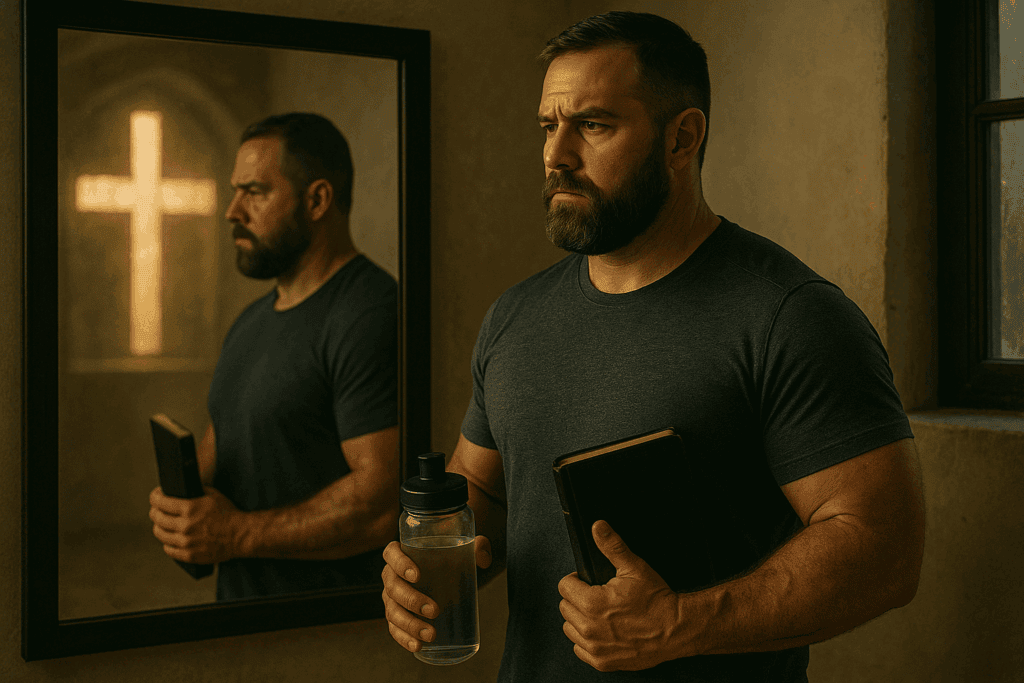
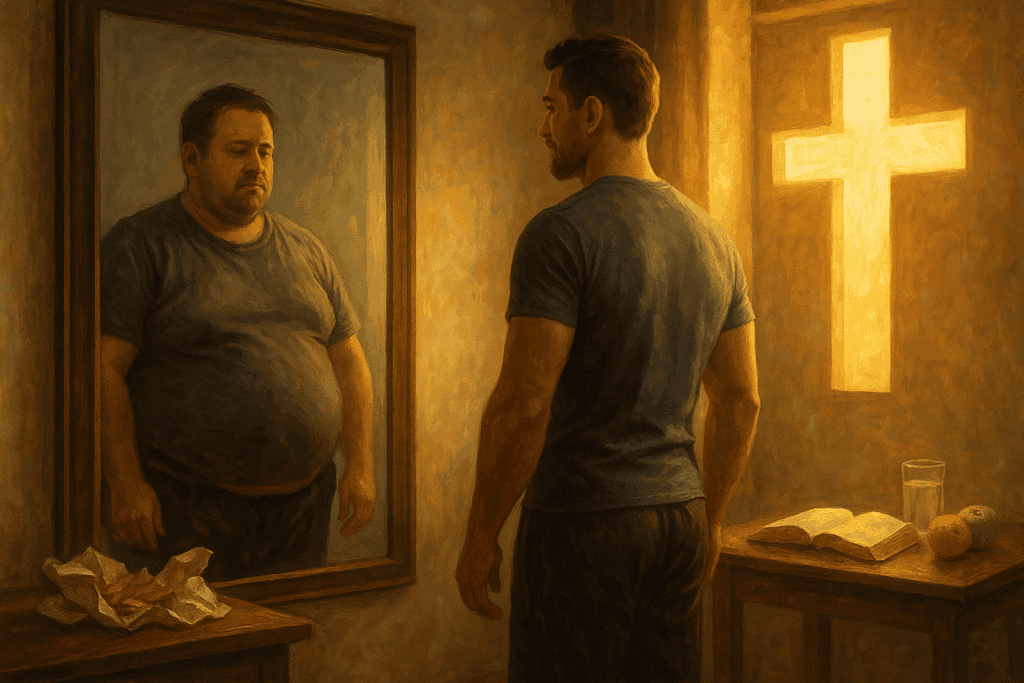
Your hands go up during worship, and by the second verse your shoulders are burning, so you bring your arms down before the song ends and hope nobody up front noticed. You know the verse. You’ve probably preached it. Your body is a temple. You still asked yourself, mid-chorus, why you can’t lose weight as a Christian when you clearly believe all the right things and still can’t make it through a worship set with your hands raised.
You can’t lose weight as a Christian not because you lack knowledge, faith, or even discipline — you have all three, and you prove it every week in a dozen other ways. You’ve never applied the identity you already carry to your plate and your body specifically. “I’m a Christian, this is what obedience looks like” already governs your marriage, your integrity at work, and how you treat people who wrong you. It stops at your neck. Willpower fails because it treats your body like a side project you white-knuckle instead of a place you already know how to obey. The fix isn’t finding new motivation. It’s running the identity you already trust God with everywhere else through the one door you’ve left standing open.
You Already Have More Discipline Than You’re Giving Yourself Credit For
Before we name the gap, look at what’s already true about you, because the argument doesn’t work unless you see this part clearly first.
You showed up and preached this past Sunday even on a week when you didn’t feel like it — grief in the congregation, a fight with your wife you hadn’t resolved, a sermon you rewrote three times at midnight. Nobody had to talk you into it. A dying man’s family got you at their bedside at 2 a.m. on a Tuesday, because that’s what shepherding costs, not because you had the energy left for it. A comfortable lie would’ve made a counseling session easier, and you told the truth instead. Your marriage vow got kept on a day you didn’t feel like keeping it. Generosity showed up in a month that was tight, because giving isn’t a decision you re-litigate every time the offering plate comes around anymore — it’s just what you do now.
None of that ran on raw willpower. Somewhere along the way, “faithful pastor,” “man who keeps his word,” “generous giver” stopped being goals you were working toward and became facts about who you already are in Christ. Skipping a hospital visit isn’t a temptation you have to talk yourself out of — it’s just not on the table. Faithfulness to your wife doesn’t get “tried” the way a diet does. You just are those things now, and the behavior follows the identity automatically, most of the time without a single moment of white-knuckled effort.
That’s the exact mechanism this entire piece is going to point at your plate and your body. You already run on it everywhere else. It stopped at your neck for one reason: nobody ever told you it was supposed to keep going.
The Moment You Already Know Too Well
You’ve dodged the family photo more than once. Somebody says “get in the picture,” and you find a reason to be the one holding the phone instead. You’ve caught your own reflection in a greenroom mirror before walking out to preach or lead a set, and looked away faster than you looked. Your kid has said something that wasn’t trying to wound you and landed like a blade anyway — a comment about the stairs, about how you throw a ball now compared to how your wife tells it you used to.
And there’s the one you didn’t expect anyone to notice: hands up in worship, shoulders tired before the bridge even hits, arms coming down early while the rest of the room is still reaching. You’ve stood in a room full of people you lead spiritually and physically run out of gas doing something that isn’t even physical exertion. It’s raising your arms.
None of this is a story about vanity. It’s a story about a gap. You know what 1 Corinthians 6:19-20 says about your body being a temple bought at a price. You didn’t just read it — you’ve taught it, more than once, from the front. The gap is between what you know and what your body is currently able to do while you’re up there teaching it.
The Data Says You’re Not Imagining the Gap
Here’s something worth sitting with before you assume this is a private failure: pastors are now more likely to be obese than the people sitting in the pews they’re standing in front of.
A 2015 Baylor University study of 539 clergy across denominations, led by sociologist Todd Ferguson and published in Social Science Research, found the obesity rate among American clergy had climbed to roughly 30 percent (Baylor University, 2015). That’s a profession that once carried some of the lowest mortality rates of any occupation in the country. That was ten years ago, and the trend didn’t reverse.
A 2024 systematic review and meta-analysis in the journal Obesity Reviews, led by Duke University researchers David Eagle and Anna Holleman, pooled 47 studies covering more than 35,000 clergy members and found a pooled obesity prevalence of 34.8 percent. More striking than the number itself is the trend line: in 2001, clergy obesity roughly matched the general population (28.9 percent versus 26.9 percent nationally). By 2021, the researchers’ model put predicted clergy obesity at 46.8 percent against 35.3 percent among general working adults — clergy obesity grew 61 percent over two decades while the national rate grew 37 percent over the same span (Eagle, Holleman, Barrera Olvera & Blackwood, Obesity Reviews, 2024).
Read that again. The people whose job is to model what a life surrendered to God looks like are now gaining weight faster than the culture they’re supposedly standing apart from. That’s not a shame stat. It’s evidence you’re not the only guy in ministry living the gap you thought was just yours.
Researchers point to specific, ordinary causes, not a mystery. Long, irregular hours and chronic stress top the list, along with isolation from peers who’d actually hold you accountable. Add a church culture built around potlucks, donuts in the fellowship hall, and casseroles delivered to your door after every hard week, and the pattern explains itself (Baptist News Global, 2015). None of that is a character indictment. It’s an occupational hazard nobody warned you about in seminary, stacked on top of a job that already asks you to pour out for everyone else first. You didn’t get here because you’re uniquely undisciplined. You got here because the specific pressures of ministry point at your plate, and nobody built you a framework for guarding it the way you guard your theology.
The Voice You’d Never Let a Friend Use on Himself
Here’s what that gap sounds like from the inside, because I’d bet you already know the exact tone of voice. You’re a loser. You know what you want and you can’t even prioritize it. Everyone else has this figured out. You’re a fraud standing up there.
If a guy in your small group said any one of those sentences about himself, you’d stop him mid-sentence. You’d remind him who he is in Christ. You’d quote him Romans 8, tell him condemnation isn’t for people in Christ Jesus, mean every word of it, and probably be right to say it. Then you’d go home and run the exact same sentences on yourself with nobody in the room to interrupt you.
That double standard — grace for every man you counsel, contempt reserved just for yourself — is worth naming instead of stepping past. I go deeper on where that internal voice comes from and how to actually retrain it in the full post on self-talk. For now, just notice this: you’d never let anyone else talk to a man you love the way you talk to yourself in the mirror before a swim you’re not going to take, or a photo you’re going to dodge again.
Godly Sorrow vs. the Shame You’ve Been Carrying
Scripture actually draws a hard line between the voice calling you a loser and the conviction that’s supposed to move you forward. “Godly sorrow brings repentance that leads to salvation and leaves no regret, but worldly sorrow brings death” (2 Corinthians 7:10, NIV). Those aren’t two flavors of the same feeling. They point in opposite directions.
Godly sorrow looks at the gap between your identity and your plate and says: this doesn’t match who I actually am, and I can bring it to God and start closing it today. Worldly sorrow — the “loser” self-talk — looks at the exact same gap and says: this proves something permanent and ugly about you, so hide, and definitely don’t bring it to anyone. One produces movement. The other produces a man who avoids the pool for a decade. If what you feel about your body right now only makes you want to hide, that’s not conviction doing its job. That’s the other kind, and it’s worth naming the difference before you take one more step in this piece.
You Already Do What You Don’t Want to Do — Romans 7 Was Written About This
Paul names this exact pattern, and it isn’t in a passage about food:
“I do not understand what I do. For what I want to do I do not do, but what I hate I do. And if I do what I do not want to do, I agree that the law is good. As it is, it is no longer I myself who do it, but it is sin living in me. For I know that good itself does not dwell in me, that is, in my sinful nature. For I have the desire to do what is good, but I cannot carry it out. For I do not do the good I want to do, but the evil I do not want to do — this I keep on doing.” (Romans 7:15-20, NIV)
Most men read that passage as being about lust, or anger, or some other named sin they’re more comfortable admitting to. Read it again with your plate in view. You know the good you want to do — eat like your body belongs to God, move it, treat it like the temple you preach on. And you keep doing something else instead, at the drive-through, at 11 p.m. with the fridge open, on the third plate at the potluck you told yourself you’d skip.
Paul isn’t writing that passage to shame you into trying harder. He’s naming a real, common experience of every believer serious enough about obedience to notice the gap between what he wants and what he does. The fact that you feel the gap isn’t proof you’re failing worse than other Christians. It’s proof the Spirit in you already agrees with God’s law about your body.
Paul doesn’t leave himself, or you, stuck in that gap either. Two verses later he asks the question you’ve probably asked in the dark, and answers it in the same breath: “What a wretched man I am! Who will rescue me from this body that is subject to death? Thanks be to God, who delivers me through Jesus Christ our Lord!” (Romans 7:24-25, NIV). The very next verse is the hinge the rest of this piece stands on: “Therefore, there is now no condemnation for those who are in Christ Jesus” (Romans 8:1, NIV). Romans 7 tells you the truth about the fight. Romans 8 tells you the fight isn’t the whole story, and it isn’t where your identity gets decided. That’s exactly where 2 Corinthians 5:17 picks up.
You’re Not Waiting to Become a New Creation — You Already Are One
Here’s where most men in ministry get stuck without realizing it. You didn’t have a rock-bottom, dramatic, before-and-after testimony. Maybe you grew up in the church. Maybe you can’t point to a single day where the old you visibly died and a new you visibly rose up in his place, the way a guy can when he gets saved out of addiction or prison. Your walk with Christ has been steady, faithful, mostly unremarkable-looking from the outside — which is a good thing. It’s also exactly why 2 Corinthians 5:17 has probably never felt like it applies to something as physical and mundane as your body.
“Therefore, if anyone is in Christ, the new creation has come: The old has gone, the new is here!” (2 Corinthians 5:17, NIV)
That verse isn’t conditional on how dramatic your testimony sounds at a men’s retreat. It’s a fact about your legal and spiritual status the moment you trusted Christ, whether that moment came with fireworks or with a quiet Sunday-school decision at age eight. I go much deeper on the Greek behind that verse — the difference between kainos (new in kind) and merely new in sequence — in the full post on your new identity in Christ. The part that matters here: you’re not waiting to become a new creation someday, once you finally get your act together physically. You already are one. You’ve just never run that status through the filter of “does this also cover my plate.”
That’s the whole hinge of this piece. You don’t need a new identity to get fit. You need to stop treating the one you already have like it stops at your neck.
Paul Trained His Body Like an Athlete, and He Told You Exactly Why
“Do you not know that in a race all the runners run, but only one gets the prize? Run in such a way as to get the prize. Everyone who competes in the games goes into strict training. They do it to get a crown that will not last, but we do it to get a crown that will last forever. Therefore I do not run like someone running aimlessly; I do not fight like a boxer beating the air. No, I strike a blow to my body and make it my slave so that after I have preached to others, I myself will not be disqualified for the prize.” (1 Corinthians 9:24-27, NIV)
Paul wrote that to a church in Corinth, a city that hosted the Isthmian Games — one of the four major athletic competitions of the ancient Greek world, alongside the Olympics. His readers had watched these athletes train. They knew the games required strict diet and months of disciplined preparation. The prize was just a crown made of pine or celery leaves, dead and brown within the week (Blue Letter Bible commentary on 1 Corinthians 9:24-27). Paul isn’t reaching for a metaphor his readers would need explained. He’s pointing at something happening in their own city and telling them: I train harder than that, on purpose, for a prize that doesn’t rot.
Notice what Paul doesn’t say here. Nowhere does he claim his body doesn’t matter because his soul is what God cares about, and nowhere does he call this kind of discipline legalism. What he says instead is that he “strikes a blow” to his own body and makes it his slave — active, repeated, physical language — specifically so that after preaching to others, he doesn’t disqualify himself. Notice, too, that he reaches for “strict training” and diet as the illustration, not a metaphor he had to strain for. Isthmian competitors followed rigid training regimens for roughly ten months before the games, diet included, under the direction of judges who enforced it (Blue Letter Bible commentary on 1 Corinthians 9:24-27). Paul is telling a room full of people who’d watched that discipline in their own stadium: I hold my body to a standard at least that serious, for a prize that doesn’t rot in a week.
Paul understood something a lot of ministry leaders miss: a man can win everyone else’s race and lose his own. This is where the name Kingdom Gladiator comes from directly. Not a mascot. A description of the actual posture Paul is describing here — trained, disciplined, in the arena, fighting for a prize that outlasts the pine wreath every secular program is really offering you.
Doesn’t 1 Timothy 4:8 Say Physical Training Barely Matters?
You’ve probably quoted this one yourself, maybe to let yourself off the hook: “For physical training is of some value, but godliness has value for all things, holding promise for both the present life and the life to come” (1 Timothy 4:8, NIV). Read in isolation, it sounds like Paul is telling Timothy not to bother with his body. Read the verse right before it, and the argument flips: “Have nothing to do with godless myths and old wives’ tales; rather, train yourself to be godly” (1 Timothy 4:7, NIV). Paul isn’t dismissing physical training. He’s using a form of exercise language — gymnazo, the root of “gymnasium” — to describe godliness, because physical training was the obvious, respected comparison in his world, not a lesser thing being dismissed.
“Of some value” isn’t Paul’s way of saying “basically worthless.” It’s a comparison, not a dismissal — the same way saying a college degree is worth something compared to eternal life doesn’t mean the degree is worthless. Paul assumes physical training is a real, recognized good in verse 8. He’s simply saying godliness outranks it. Nowhere does he say a man gets to neglect one because he’s pursuing the other. You’ve been misusing your own proof text to excuse the exact gap this piece is naming.
Why Willpower Keeps Failing You — And It’s Not a Character Flaw
For decades, psychology’s dominant explanation for why people fail at self-control was “ego depletion.” Psychologist Roy Baumeister made the idea famous in 1998: willpower works like a muscle or a fuel tank, a limited resource that gets used up every time you resist a temptation or make a hard decision, leaving less in reserve for the next test of self-control (Baumeister et al., Journal of Personality and Social Psychology, 1998). It became one of the most cited findings in modern psychology. It’s also the quiet assumption behind almost every “just try harder” diet plan you’ve ever started on a Monday.
Here’s what almost nobody selling you willpower-based advice will tell you: that theory has largely collapsed under actual scientific scrutiny. A 2016 preregistered replication across multiple independent labs, involving 2,141 participants, found no meaningful evidence for the ego-depletion effect at all (Hagger et al., Perspectives on Psychological Science, 2016). A larger 2021 replication spanning 36 labs and 3,531 participants reached the same conclusion (Vohs et al., Psychological Science, 2021). Willpower, it turns out, isn’t a gas tank that empties. The “running out” you feel isn’t a biological inevitability — it’s closer to a belief that becomes true because you expect it to be.
So if willpower isn’t a depleting resource, what actually predicts whether a man follows through? Psychologist Daphna Oyserman’s research on identity-based motivation offers a better answer. People act in ways that feel congruent with whichever identity is active in the moment. They also interpret difficulty itself differently depending on which identity that is (Oyserman, “Identity-Based Motivation,” 2015). When a hard moment gets filtered through “this is who I am,” difficulty reads as proof the goal matters. When the same hard moment gets filtered through willpower alone, difficulty reads as proof you’re failing — and you quit.
| Willpower-Based Approach | Identity-Based Approach | |
|---|---|---|
| What it sounds like | “I’m trying not to eat that.” | “That’s not what I eat anymore.” |
| Under real pressure | Negotiates — one exception feels survivable | Doesn’t negotiate — there’s nothing to argue with |
| Where it runs out | Treated as a limited daily resource | Doesn’t run out; it’s a settled fact about you |
| What difficulty means | Proof you’re failing or weak | Proof the thing matters enough to cost you something |
| Scriptural anchor | None — a secular, and now scientifically shaky, model | 2 Corinthians 5:17 — you already are who you’re trying to become |
This is exactly why every 30-day challenge and macro app you’ve tried failed the same way, at the same point, a few weeks in. They were all built on the model that just failed to replicate. You didn’t lack willpower. You were running a system that was never going to hold, because the resource it depends on was never real to begin with.
This Isn’t Another 30-Day Challenge
You’ve probably already tried GNC supplements, a random stack somebody recommended, carnivore for a few weeks, CrossFit, calorie counting, a macro app, a secular 30-day challenge you found online, keto. Some of it worked for a stretch. None of it stuck past three weeks, and you already know why if you’re honest: every one of those was a borrowed program built for a man whose deepest motivation is aesthetics, not obedience. A macro calculator has nothing to say about why you’re standing in front of the fridge at 11 p.m. after a hard pastoral care call. It was never built to.
This isn’t a seventh program to add to that graveyard. It’s the removal of the wall you built between “spiritual disciplines” and “physical discipline” — as if the same man who fasts, tithes, and disciples other men out of pure identity somehow needs an entirely different psychological system to manage his plate. He doesn’t. He needs the wall gone.
The Sentence That Actually Changes Things
Here’s the practical version of everything above, in the exact words I use on myself: That’s not what I do anymore. I don’t eat that. Wasting hours doomscrolling isn’t me anymore. I don’t go to those websites. I’m not that person.
Notice what that sentence isn’t: a negotiation, an “I’m trying not to” that leaves the door cracked open. When I catch myself reaching for something and run it through “that’s not what I do anymore” instead of “I shouldn’t do this,” there’s nothing left to argue with. Willpower gives the tempting thing a seat at the table and then tries to out-argue it. Identity doesn’t invite it to sit down in the first place.
This only works because it’s true, not because it’s a mental trick. You’re not pretending to be someone you’re not when you say “that’s not who I am.” If you’re in Christ, it’s the most accurate sentence available to you. The days I actually take ownership of that — instead of trying to distract myself or outlast a craving through sheer effort — are the days I see real success. Not because I found more discipline that day. Because I stopped negotiating with a version of myself that Scripture says is already gone.
How to Actually Run This When the Moment Hits
This isn’t a mantra to repeat in the mirror before your day starts and forget by 3 p.m. It’s a tool for the exact second temptation shows up, and it works the same way every time.
Name the moment out loud, even silently. Standing at the table of donuts after service, staring at the fridge after a hard counseling session, reaching for the fourth plate at the church potluck — name what’s actually happening instead of drifting into it on autopilot. Awareness is the whole first step, because you can’t apply an identity to a moment you never consciously noticed.
Speak the identity, not the rule. Not “I shouldn’t have another donut” — that’s a rule, and rules invite negotiation. “That’s not what I eat anymore” is a fact about who you are. Say it the same tone of voice you’d use to tell someone your name.
Don’t negotiate with the counter-offer. Your mind will immediately produce a reason this time is different — you earned it, it’s a special occasion, you’ll start again Monday. Willpower engages that argument and sometimes loses it. Identity doesn’t have to win the argument, because it never agreed to have one. “That’s not what I do anymore” isn’t a position you’re defending. It’s a fact you’re stating.
Let God in on it before you’re already mid-failure. The best time to pray about the fridge is before you’re standing in front of it at 11 p.m., not after. Bring Him the actual moment, not a vague New Year’s-style resolution. “God, I’m about to face this specific thing tonight” is a real prayer a busy pastor can actually pray in fifteen seconds, and it does more than a generic ask for discipline ever will.
My Own Shame Was in the Water
I need to tell you where I actually am with this, because I’m not writing any of this from the other side of a finish line.
I grew up loving to swim. The water has always been a peaceful place for me — I could spend hours in a pool, at a lake, on a beach, and mean it, no phone, no agenda, just floating. I don’t go near the water anymore. Not because I stopped loving it. Because I hate taking my shirt off in front of people, because of how fat I think I look, more than I love the one place that’s always brought me peace. I gave up something I genuinely love because of shame about my own body. Sit with how backwards that is for a minute, because I’ve had to.
I’ve spent over a decade as a certified personal trainer, coaching other people through the exact discipline I’ve failed to apply to my own body, at 260 pounds and roughly 35 percent body fat. I’ve stood in front of a client cueing perfect squat depth, counting their reps out loud with real enthusiasm, while a quieter voice underneath was telling me I was a fraud who had no business teaching anyone anything about discipline. That voice doesn’t stay in the gym.
That feeling doesn’t stay contained to the gym floor or the pool deck, either. When your body isn’t where your convictions say it should be, the shame doesn’t politely wait its turn. It leaks into how you second-guess a sermon, a decision at work, a conversation with your wife. My confidence across the board took a hit I didn’t expect a number on a scale to be able to reach.
I’m telling you this because I built the Holy Diet and the Temple Training System, and I still haven’t crossed my own finish line. I’m walking this exact identity-based path right now, in real time, toward 205 to 215 pounds and under 15 percent body fat — not lecturing you from a place I’ve already arrived at. If you’ve been waiting to hear this from a guy who’s already there, you’re going to be waiting a long time, because that guy usually hasn’t actually lived the gap he’s teaching about.
“Isn’t This Just Another Way to Feel Guilty?”
“I already feel enough shame about my body. Won’t this just add to it?” No — shame says “you’re a failure, hide.” Conviction says “this doesn’t match who you actually are, and you can close that gap.” This piece is aimed at conviction, not shame. If you finish reading this and just feel worse with nowhere to go, I’ve failed at the one job this post has. The next section tells you exactly where to go instead.
“Isn’t caring about my body vanity, especially for someone whose calling is supposed to be about the inward man?” Paul didn’t think so, or he wouldn’t have used his own physical training as the model for spiritual seriousness in 1 Corinthians 9. Stewardship of your body isn’t competing with your calling. Neglecting it while preaching that bodies matter to God is the actual contradiction.
“I’ve tried identity language before — ‘I’m a new creation’ — and it didn’t stick.” Most men say that sentence about their salvation and never once run it through their plate. Saying “I’m a new creation” in general and saying “that’s not what I eat anymore” in the specific moment the temptation shows up are different exercises. This piece is asking you to do the second one, not just believe the first one more sincerely.
“What if I fail again? I’ve started over so many times.” Then you’ll have one more data point that willpower alone doesn’t hold, which the research above already told you. Starting from identity instead of motivation is a different mechanism, not a more intense version of the same one that’s already failed you.
“Is this legalism? Do I have to follow Old Testament food laws exactly?” No, and I’m not going to dodge the question the way a lot of content like this does. Jesus said plainly, “Do not think that I have come to abolish the Law or the Prophets; I have not come to abolish them but to fulfill them” (Matthew 5:17, NIV). The point was never earning righteousness through a grocery list — nobody’s diet has ever saved anybody. The point is that God designed your body and told you plainly what it runs best on, and ignoring that design doesn’t stop being true just because grace covers you when you get it wrong. This piece isn’t asking you to add a new law to justify yourself. It’s asking you to let the identity you already have by grace start showing up at your table.
What You’re Modeling, Whether You Mean To or Not
Paul told the Corinthian church, “Follow my example, as I follow the example of Christ” (1 Corinthians 11:1, NIV). He said it knowing people were actually going to do it. Somebody in your church is going to do the same thing with you, whether or not you asked for it. Your kid, watching you decline the pool again. A younger man in your discipleship group, quietly deciding that this is just what it looks like to get older and busier in ministry — soft, tired, avoiding cameras, and calling it normal because his pastor does it too.
You already know this instinct in every other area. You wouldn’t let a young man watch you cut a corner on integrity and shrug it off as no big deal. You’d correct it, in yourself first. The same standard applies here, and it’s not about vanity or a six-pack. It’s about whether the next generation of men in your church inherits a model of discipleship that includes the body, or one that quietly teaches them faith and physical stewardship live in separate rooms. You’re already being followed. The only question is what they’re following you into.
Why Listen to Me
I’m a certified personal trainer with over a decade in the fitness industry — front desk to minority owner across seven boutique gym locations, general manager of the largest location in a California-based big-box gym chain, 100-plus one-on-one clients trained, thousands of gym members served. I built the Holy Diet and Temple Training System from a direct study of Scripture, and Kingdom Gladiator is the program built on top of it.
I’m not writing to you from a finished result. I’m writing from inside the exact tension this piece describes — trained, credentialed, and still closing my own gap in real time. More on that transformation, documented honestly as it happens, at the About page.
What I Want You to Do in the Next 24 Hours
Don’t just sit with this and feel it — that’s the shame response, and it changes nothing. In the next 24 hours, do the Kingdom Reset: a free five-day water-only fast, paired with a daily devotional, offered inside the Kingdom Gladiators community on Skool. It exists for exactly this moment.
Before you eat again, have the hard conversation you’ve been avoiding — not with me, with God. Tell Him plainly where you actually are. Tell Him where you want to go. Invite Him into the gap between the two instead of managing it alone in silence, the way you have been. You already have the identity that makes this possible. You’ve just never handed Him your plate along with everything else you’ve already surrendered.
Go deeper on the mechanism behind this piece in Renewing Your Mind, on the self-talk pattern in Self-Talk, and on the full identity case in New Identity in Christ. For the complete biblical blueprint on food, movement, and fasting, the master pillar is here.