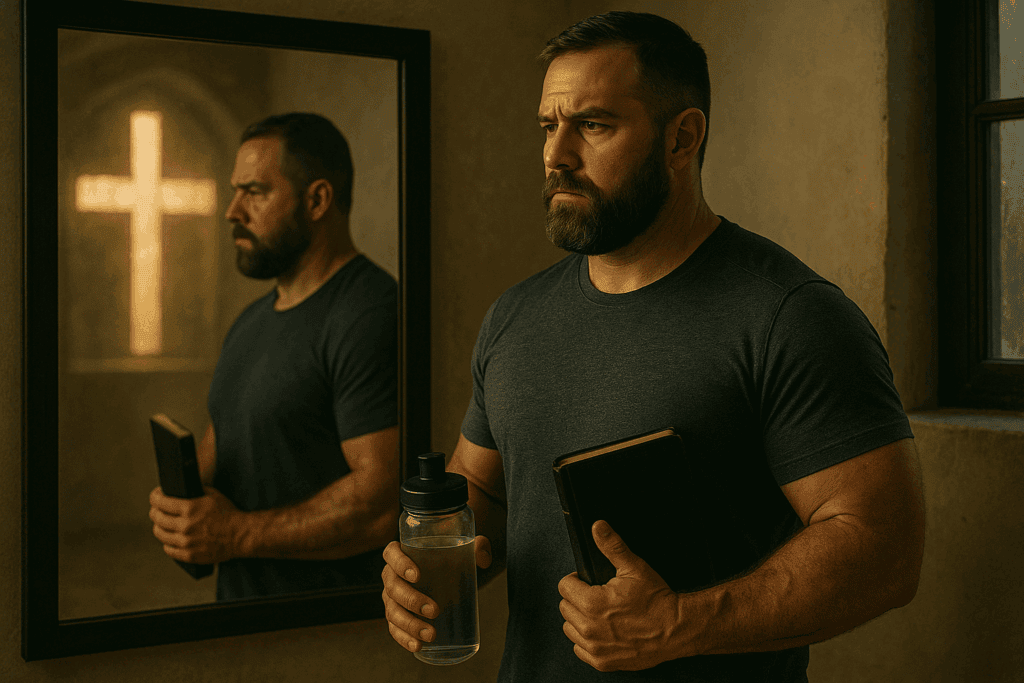
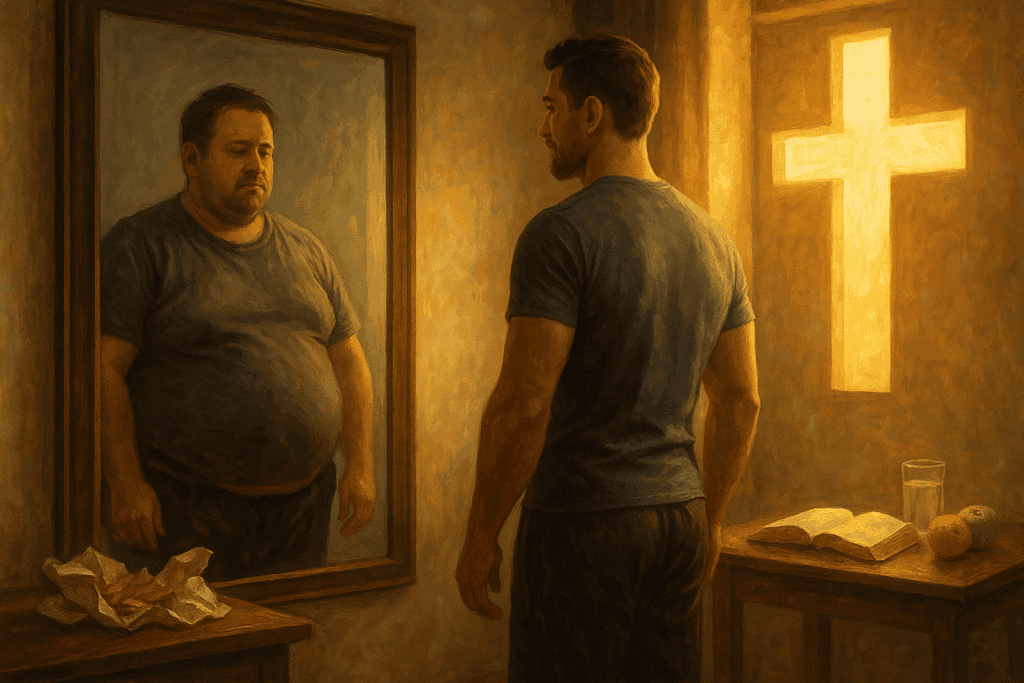
You’ve done the random workout of the day before. Monday is chest and arms because that’s what feels good to hit. Wednesday is whatever YouTube video showed up first. By week three you’re sore in places you didn’t train and skipping the gym because your shoulder still hurts from Tuesday. That’s not a discipline problem. That’s a program problem, and it’s exactly why I built the Temple Training System as a 40 day Christian workout program instead of another random split.
The Temple Training System is a 40 day Christian workout program built in four sequential phases: Ark Blueprint, Samson Strength, Armor of God Total Body, and Cross Fitness. Each phase runs 40 days, a number that shows up again and again in scripture as a period of testing and preparation before something bigger. You build muscle and movement patterns in Ark Blueprint, get strong in Samson Strength, train your whole body with real training science in Armor of God, then finally earn the right to train with variety in Cross Fitness. It’s the opposite of the workout-of-the-day model most men start with and burn out on. Below is the full breakdown of why I built it this way, phase by phase.
Why I Rejected the Workout of the Day Model
I’ve been training people since 2009. In that time I’ve watched more men than I can count start with random workouts of the day and end up hurt, burned out, or both.
Here’s why. The workout of the day model is built to be competitive, intense, timed, and aggressive from day one. That’s the whole appeal — it feels hard, it feels impressive, and it gives you a score to beat tomorrow.
What it isn’t built to do is teach you the movement first.
I’ve seen this pattern play out across more clients and gym members than I can count over fifteen-plus years in this industry. Guys come in fired up, throw themselves at whatever’s trending that month, and either get hurt or burn out within a few weeks. It’s not one bad client or one unlucky story. It’s the predictable result of a model built for competition instead of foundation.
A man who’s never deadlifted correctly doesn’t need a workout that asks for 30 deadlifts for time. He needs to learn what a deadlift actually feels like at a weight he can control, then build from there. Skip that step and you get one of two outcomes. He gets hurt, because his form breaks down the moment fatigue and a clock enter the picture together. Or he plateaus fast, because he never built the base strength the harder version of the movement requires.
Slower is not the same as weaker. A firm foundation takes longer to build than a hard workout takes to finish, but it’s the difference between a man who trains consistently for years and a man who quits by spring.
The Overdo-It Trap I See Constantly
Here’s the pattern I’ve watched play out more times than I can count, in myself and in the men I’ve trained. A guy decides he’s finally serious. He shows up, picks the hardest version of a workout he can find, and gives it everything — 100% on day one.
Then he can’t move for four days.
His legs are so sore he can’t get down the stairs without holding the rail. His shoulders are so tight he can’t lift his arms above his head to shower comfortably. And by the time his body has recovered enough to train again, a week has passed, his motivation has cooled off, and he’s already halfway back to where he started.
That’s not commitment. That’s a program that was never built to be repeated. A workout that leaves you unable to train again for four days isn’t proof you worked hard. It’s proof the program failed you, because a program’s whole job is to get you to show up again tomorrow, not to wreck you so badly you can’t.
Temple Training is built specifically against this pattern. Every phase progresses on purpose, in small enough steps that you can actually train again the next day, or the day after that, instead of needing a week to recover from a single session. That’s not a softer approach. It’s the only approach that produces a man who’s still training in month six instead of a man who peaked hard for one day and disappeared.
The Crawl-Walk-Run Principle Behind Every Phase
Temple Training is built on a simple idea: you have to crawl before you walk, walk before you run, and run before you sprint.
Phase 1 is the crawl. You learn eight foundational lifts and build real muscle before anything else is asked of you. Phase 2 is the walk. You take that foundation and get strong with a proven strength program. Phase 3 is the run. You’re training your whole body, every session, with real volume and frequency behind it. Phase 4 is the sprint — the only phase where workout-of-the-day style training shows up at all, because by then you’ve earned it.
That last part matters. Cross Fitness isn’t off the table forever. It’s just not where you start. By month four, you’ve built the movement literacy and the strength base to make that kind of training productive instead of reckless. The same workout that would have hurt you in week one becomes a legitimate test of what you’ve built by day 121.
Why 40 Days, Not 30 or 60
Forty shows up throughout scripture as a specific length of time, and it’s never random. Every time it appears, it marks a deliberate stretch of testing and building that has to happen before the next thing can begin.
The flood. “For forty days the flood kept coming on the earth” (Genesis 7:17, NIV). Noah wasn’t ready to step onto dry ground the moment the rain started. The water had to finish its work first.
Moses on the mountain. “Moses was on the mountain forty days and forty nights” (Exodus 24:18, NIV), and again later in Exodus 34:28. He came down changed, carrying the law, carrying something he didn’t have when he went up.
The twelve spies. Before Israel could take the promised land, twelve men “explored the land forty days” (Numbers 13:25, NIV). They weren’t ready to move until the scouting was finished — even though the report they came back with split the nation in two.
Goliath’s taunt. “For forty days the Philistine came forward every morning and evening and took his stand” (1 Samuel 17:16, NIV), before David ever stepped onto the field. Forty days of pressure and provocation, building to the moment David actually showed up.
Nineveh’s warning. Jonah walked into the city and said, “Forty more days and Nineveh will be overthrown” (Jonah 3:4, NIV). Forty days of decision, before judgment or mercy landed.
Elijah’s journey. After Jezebel threatened his life, Elijah “traveled forty days and forty nights until he reached Horeb, the mountain of God” (1 Kings 19:8, NIV) — a stretch of wilderness travel before God met him in the whisper on that mountain.
Jesus in the wilderness. Before His public ministry ever began, Jesus “fasted forty days and forty nights” (Matthew 4:2, NIV), tested by the devil in the wilderness, before He preached a single sermon or healed a single person.
Every one of those is the same shape. A defined, limited stretch of testing and building, followed by readiness for what comes next. Nobody in any of those stories got to skip the forty days and jump straight to the outcome. Noah couldn’t rush the flood. Moses couldn’t rush the mountain. Israel couldn’t rush the scouting. Jesus didn’t begin His ministry a day early.
That’s exactly how I want you to see each 40-day phase of Temple Training. Not a countdown to a finish line you’re impatiently waiting to cross. A deliberate stretch of testing and building that has to happen before you’re ready for what’s next. You don’t skip Ark Blueprint to get to Samson Strength faster, any more than Israel could’ve marched into Canaan blind without the forty days of scouting first. The waiting isn’t wasted time. It’s the mechanism the whole system runs on.
The Four Phases at a Glance
Here’s the full system before we go phase by phase.
| Phase | Name | Length | Focus | Modeled On |
|---|---|---|---|---|
| 1 | Ark Blueprint | 40 days | Foundational muscle-building, movement mastery | Tim Ferriss’s The 4-Hour Body |
| 2 | Samson Strength | 40 days | Progressive overload, raw strength | The 5×5 method (StrongLifts) |
| 3 | Armor of God Total Body | 40 days | High-frequency full-body training | Ryan Fischer / Chalk Performance Training |
| 4 | Cross Fitness | 40 days | Rotating, tested variety | Biblical Warrior WOD library |
Underneath all four phases runs Walking with God — 20 to 40 minutes a day of low-intensity cardio, starting on day one, even during the fast that precedes Phase 1. More on that below.
Once you’ve hit your goal weight, Phases 3 and 4 become a maintenance rhythm you can cycle between indefinitely. If you want to add more size or strength after that, you go back through Phases 1 and 2. Nothing about this system ends at day 160. It’s built to keep working for you for years, not just one cycle.
Phase 1: Ark Blueprint — Building the Foundation
Ark Blueprint is named after Noah. Before the flood ever came, Noah spent years building something most people around him thought was pointless. He wasn’t reacting to a crisis. He was building in advance, on instructions he trusted, long before he could see the payoff.
That’s the posture I want you in for the first 40 days. You’re not chasing a personal record. You’re building the structure everything else in this system stands on.
Here’s how it actually works. You pick eight exercises — eight, one for each of the eight people who walked onto the ark with Noah: Noah, his wife, his three sons, and their three wives (Genesis 7:13) — and you work through them consistently, day after day. You train each lift for eight to twelve reps. Once you can complete two sets of twelve reps at a given weight, you move up in weight and start the rep count over. That’s the whole progression model. No max-effort testing, no guessing, just a simple rule you follow every session: hit twelve reps twice, add weight.
I like starting every client here because it teaches you something a random workout never will: how much you can actually lift, and what your own body feels like under a controlled, repeatable load. You’re doing the same lifts often enough to notice real progress instead of guessing at it. A man who’s spent his gym life bouncing between programs usually has no real idea what he can lift — he’s never stayed on anything long enough to find out. Forty days on eight lifts fixes that fast.
The approach borrows from Tim Ferriss’s The 4-Hour Body (2010), where he lays out a minimalist approach to building muscle quickly using a small number of compound lifts trained close to failure with careful attention to form and time under tension. I’ve adapted that idea into eight lifts run on a straightforward double-progression model — add reps until you hit the ceiling, then add weight and start again. None of it is flashy, and it’s never going to trend on social media. It’s the version of training that actually works when you do it for forty straight days instead of three.
By day 40, you’re not just stronger. You know your own numbers. You know what a controlled set of eight reps feels like versus a sloppy one, what real muscular fatigue feels like versus just being tired. That knowledge is what makes every phase after this one actually work, because you’re no longer guessing at your own capacity going into it.
To give you a sense of what those eight lifts actually cover, without handing over the exact prescribed program: think one lower-body push (a squat pattern), one lower-body pull (a hinge pattern like a deadlift or Romanian deadlift), one horizontal upper-body push (a bench or floor press), one horizontal upper-body pull (a row), one vertical push (an overhead press), one vertical pull (a pull-up or lat pulldown), one direct arm movement, and one core movement. Eight categories, eight lifts, covering every major movement pattern your body has. Nothing exotic. Nothing that requires special equipment. Just the fundamentals, trained consistently enough to actually stick.
Phase 2: Samson Strength — Getting Genuinely Strong
Samson is the strongest man in the Bible, and that’s really the whole reason for the name. This phase is about raw strength, full stop.
Samson Strength runs on the 5×5 method — five sets of five reps on a small number of compound barbell lifts, adding weight steadily as you’re able to handle it. It’s the same structural approach behind StrongLifts 5×5, one of the most tested progressive-overload templates in strength training, built around big compound movements like the squat, the bench press, the barbell row, the overhead press, and the deadlift.
Where Ark Blueprint had you working eight exercises for reps in the 8-12 range, Samson Strength narrows the focus considerably. Fewer exercises. Heavier loads. Straight progressive overload, session after session, with the same simple rule driving everything: if you complete all five sets of five reps, you add weight next session.
This is the shift from “I can do the movement” to “I can do the movement under real weight.” You already know your lifts from Phase 1 — you’ve spent forty days learning what good form feels like under a manageable load. Now you spend forty more days adding plates to the bar and watching the numbers climb in a way most men never experience, because most men never stay on one program long enough to see it happen.
Men chronically underestimate how strong they can get in six weeks of dedicated strength work, because they’ve never trained this way before — never picked a small number of lifts and just added weight, week after week, without switching things up out of boredom or chasing the next trend. That’s the whole secret, if you want to call it that. There isn’t a hack. You do the same five lifts, you add weight when you can, and the strength comes. It’s not exciting to describe. It’s extremely effective to do.
Phase 3: Armor of God Total Body — Training Like Your Body Is Worth Protecting
“Put on the full armor of God, so that you can take your stand against the devil’s schemes” (Ephesians 6:11, NIV). Paul lists six pieces in the verses that follow: the belt of truth, the breastplate of righteousness, feet fitted with the readiness that comes from the gospel of peace, the shield of faith, the helmet of salvation, and the sword of the Spirit, which is the word of God (Ephesians 6:14-17, NIV).
Armor of God Total Body takes that image and builds a training week around it. You rotate through four full-body workouts, doing two or three of them a week depending on your schedule. Every single workout trains your whole body — but each one has a priority area, the way each piece of armor covers a different part of you. Back day carries the breastplate theme, covering what’s most exposed and central. Chest day is your pressing strength. Core day is the belt of truth, the thing that holds everything else in place and keeps the rest of the armor from coming loose. Leg day covers your hamstrings and quads — feet fitted and ready to move, ready to stand your ground. Shoulders, biceps, and triceps get direct work across all four sessions — your shield and your sword, the tools you actually hold up and swing.
Here’s why this phase looks completely different from the first two, and why that difference is intentional rather than random. Ark Blueprint and Samson Strength are about learning and loading a small number of lifts. Armor of God is about frequency — training every major muscle group multiple times a week instead of once.
This isn’t just a preference of mine. It’s backed by real research on how muscle actually grows. Muscle protein synthesis — the biological signal your body uses to build new muscle tissue after a workout — spikes after a training session and returns to baseline within roughly 24 to 48 hours in a trained lifter (Phillips et al., 1997, American Journal of Physiology-Endocrinology and Metabolism). Train a muscle once a week, the traditional bodybuilding “chest day, back day” split most gyms are still built around, and you spend most of the week with that signal sitting flat, doing nothing for you. Train it three to five times a week instead, spreading the same total workload across more sessions, and the signal stays elevated far more of the time.
A 2016 systematic review and meta-analysis by Schoenfeld, Ogborn, and Krieger, published in the Journal of Sports Sciences, looked at the relationship between weekly training volume and muscle growth across multiple controlled studies and found a real dose-response relationship — more weekly sets per muscle drive more growth, up to a point, after which the returns flatten out and then decline as fatigue outpaces recovery. The takeaway isn’t “more is always better.” It’s that hitting each muscle group with real, high-quality volume spread across the week beats hitting it once with everything you’ve got and then leaving it alone for six days.
I modeled the structure of Armor of God on Ryan Fischer’s Full Body Aesthetics program at Chalk Performance Training, which runs on this exact high-frequency, full-body logic — every priority muscle trained several times a week in short, focused doses instead of one exhausting session that leaves you sore for days. Fischer’s coaching guide walks through the same underlying science I’ve just described: muscle growth plateaus once you push much past five to ten hard sets for a single muscle in one session, so spreading volume across more sessions in the week keeps every set inside the productive zone instead of piling up junk volume at the end of an overlong workout.
That’s the training logic behind this phase. It’s not a bodybuilding split, and it’s not a strength-only cycle either. It’s frequent, full-body, and built to keep every muscle group fresh enough to actually respond, week after week, instead of grinding it into the ground once and calling that progress.
Phase 4: Cross Fitness — Earning the Right to Freedom
By day 121, something has changed. You know eight lifts cold from Ark Blueprint. You’ve built real strength in Samson Strength. You’ve trained your whole body with real frequency and volume in Armor of God. Cross Fitness is where all of that gets tested.
This is the one phase where I let go of the strict structure and hand you a rotating library of workout-of-the-day style training. It’s not the CrossFit brand or company — it’s a “choose your own adventure” workout database built specifically for Kingdom Gladiator, using biblical warriors as the theme instead of borrowing names from an existing fitness brand.
A few examples from the library:
GOLIATH — the heavy-strength workout. For time: 30 deadlifts, 20 clean and jerks, 10 heavy front squats, 20 burpees, 30 kettlebell swings. Heavy, slow, brutal. Everything about this one is built around load, the way Goliath himself was built around size and force.
DAVID — five rounds for time: 10 deadlifts, 10 burpees, 10 box jumps, 10 push-ups, and a 100-meter sprint. The theme is right there in the story — small doesn’t mean weak. Faith makes you dangerous, and a smaller man with the right conviction beats a giant every time scripture tells the story.
CALEB — a rugged endurance test: a one-mile run, 100 walking lunges, 50 push-ups, 40 kettlebell swings, 30 pull-ups, 20 burpees, and another one-mile run to close it out. Caleb was 85 years old when he told Joshua he was still ready to take the mountain (Joshua 14:10-12). That’s the whole point of this workout — readiness doesn’t expire, and neither should yours.
THE ARMOR — for time: 50 burpees, 50 kettlebell swings, 50 goblet squats, 50 push-ups, 50 sit-ups, and 50 walking lunges. A callback to the phase you just came from, in a single brutal set.
None of this would be safe to hand a man on day one. It’s exactly what makes sense to hand him on day 121, because random and reckless aren’t actually the same thing. The workouts aren’t reckless here. They’re testing what you’ve already built over the last three phases.
And Phase 4 isn’t a dead end. You can rotate through the WOD library indefinitely, or you can drop back into Ark Blueprint, Samson Strength, or Armor of God any time you want to focus on building more muscle, more strength, or more structure again. This is the phase built to flex around the rest of your life, once the rest of your life has a strong body underneath it.
What the Full 160 Days Actually Looks Like
Four phases, forty days each, comes out to 160 days from the day you start Ark Blueprint to the day you finish your first full pass through Cross Fitness — a little over five months. I want to be straight with you about what that actually looks like in real life, because it’s not a straight line.
Week one of Ark Blueprint usually feels easy, almost too easy, because you’re learning movement patterns at a manageable weight. That’s on purpose. Weeks three and four are where the double progression starts asking real questions of you, because you’re adding weight regularly and it stops feeling easy. Samson Strength is where most men tell me they feel the biggest jump in confidence, because watching a barbell number climb week over week does something to how you see yourself that a scale number never quite does. Armor of God is the grind phase — less dramatic week to week, more like compound interest, where the changes are happening but you have to trust the process because you won’t always feel them day to day. By the time you reach Cross Fitness, most men have stopped thinking of this as “a program” and started thinking of it as just how they train now.
Life doesn’t pause for 160 days. You’ll travel. You’ll get sick. A work deadline will eat your week. None of that means starting over — it means picking back up where you left off in whichever phase you were in, because the structure is still there waiting for you. That’s the entire advantage of a phased system over a random one: there’s always a next step defined, even after a bad week.
Reclaiming the Arena, Even in the Workout Names
I didn’t name this brand Kingdom Warrior. I named it Kingdom Gladiator, on purpose, and that choice shows up even in how Cross Fitness workouts get named.
Paul described his own life in arena and beast-fighting terms more than once. “If I fought wild beasts in Ephesus with no more than human hopes, what have I gained?” (1 Corinthians 15:32, NIV). He described himself and the other apostles as “men condemned to die,” put “on display at the end of the procession, like men condemned to die in the arena” (1 Corinthians 4:9, NIV). Early Christians were historically martyred in Roman arenas for the crowd’s entertainment — Ignatius of Antioch, thrown to wild beasts in Rome around 108 AD, and Perpetua and Felicity, martyred in the arena at Carthage in 203 AD, are two of the most documented cases.
Some people push back on the gladiator name, and I understand why. Gladiators were largely slaves and criminals, forced to fight for pagan entertainment — not exactly a flattering origin. But that’s the point, not a problem with it. Christians were thrown into that exact system, into an arena built specifically to destroy them, and it became one of the clearest symbols of unshakeable faith in early church history precisely because of how brutal that arena was, not despite it. We’re not reclaiming the arena because it was noble. We’re reclaiming it because it was built to break people like us, and it didn’t.
That’s why a Cross Fitness workout can be named GOLIATH or THE COLOSSEUM or THE SPARTAN without contradiction. The arena was never the enemy’s territory to keep. It’s just a place that gets rebuilt for a different purpose now.
Walking with God: The Cardio Underneath Every Phase
Every phase of Temple Training runs on top of one constant: Walking with God, 20 to 40 minutes a day of low-intensity cardio, starting on day one — even during the fast that leads into the program.
This isn’t just cardio. It’s devotional time. Worship music or quiet time alone with God while you walk. It’s built in from the very start because your body and your walk with God were never meant to be separate rooms in the same house. For a lot of men, this ends up being the part of the day they look forward to most — not because it’s the hardest thing they do, but because it’s the one part of the day that’s just them and God, moving.
If you’re worried this is one more thing competing for your time, it isn’t built that way on purpose. Twenty to forty minutes of walking fits around a sermon podcast, a worship playlist, or a phone call you already needed to make. It’s not asking for a second workout on top of your training day. It’s asking you to use time you’re probably already spending some other way, and hand it over to something that builds both your body and your walk with God at once.
The Real Reason Most Christian Men Quit Training
I don’t think most Christian men who quit training have a discipline problem in general. I’ve watched too many of them run a business, raise kids, and show up faithfully for a ministry role to believe that. The discipline is there. It’s just not transferring to their body.
Paul names this exact tension in Romans 7: “I do not understand what I do. For what I want to do I do not do, but what I hate I do… For I have the desire to do what is good, but I cannot carry it out” (Romans 7:15, 18, NIV). That’s not a verse about training, but it describes the exact gap I hear from men constantly — the guy who can hold a budget, lead a small group, and coach his kid’s team, but can’t get through a week of consistent workouts without falling off.
I think the reason is simpler than it looks. It’s not that his willpower is weaker in this one area. It’s that every program he’s tried asked willpower to do the work structure should have been doing instead. A random workout of the day, chosen fresh every session based on how motivated he feels that morning, puts the entire burden on willpower, every single day, forever. Of course that fails eventually. Willpower is not a renewable resource you can run on forever without a system underneath it.
Temple Training moves the weight off willpower and onto structure. On any given day, you don’t have to decide what to do or how hard to push — the phase you’re in already decided that for you. All you have to do is show up and follow the next step. That’s a fundamentally different ask than “find it in yourself to go hard today,” and it’s why men who’ve failed at this before tend to actually finish this one.
Is Training Your Body Even a Spiritual Thing?
I hear this question a lot, in different forms. Isn’t caring about how your body looks just vanity dressed up in Bible verses?
Here’s where I land on it, and I don’t think it’s complicated once you see the actual distinction. Vanity is about being seen. Stewardship is about being faithful with what you’ve been given, whether anyone’s watching or not. Paul asks the Corinthian church directly, “Do you not know that your bodies are temples of the Holy Spirit, who is in you, whom you have received from God? You are not your own; you were bought at a price. Therefore honor God with your bodies” (1 Corinthians 6:19-20, NIV). That’s not a verse about looking good in a photo. It’s a verse about ownership — your body was bought, not earned, and it belongs to Someone who asks you to care for it.
Training your body inside Temple Training isn’t about chasing a six-pack for its own sake. It’s about being physically capable to show up for your wife, your kids, your ministry, and the people who are watching how you actually live out what you preach — not just what you say from the platform on Sunday. That’s the whole difference between vanity and stewardship. One is about being admired. The other is about being ready.
What Makes This System Against the Grain
I’m against constant program-hopping. I’m against the no-plan, CrossFit-only approach that throws a man into competitive, aggressive training before he’s built the foundation to handle it. And I’m against chasing soreness as proof that a workout worked.
Here’s the position I actually hold, and it goes against almost everything mainstream fitness content tells men right now: I would rather have a client show up and give 50% every single day than give 100% one day a week.
That’s not a lack of intensity. It’s math. A man who trains at 50% effort five days a week accumulates more total work, more consistency, and more actual progress than a man who trains at 100% once and then can’t move for four days. The “go hard or go home” model sounds impressive. It produces men who go hard, then go home for the rest of the week, because they’re too sore and too tired to show up again.
Here’s what that looks like side by side.
| What Most Programs Do | What Temple Training Does |
|---|---|
| New random workout every session | Same core lifts for 40 days, progressed on purpose |
| Rewards intensity over consistency | Rewards showing up again tomorrow |
| Soreness treated as proof it worked | Recovery treated as part of the program |
| One phase, no next step defined | Four phases, each one setting up the next |
| Built around a 30-day challenge | Built to run for years, cycling as needed |
Temple Training is built to progress over time, on purpose, so a man can actually train consistently and see real results — instead of the stop-start-stop-start cycle that ends every January and every “fresh start Monday” for the rest of his life.
Who Temple Training Is For
This system was built with a specific man in mind — married, 30 to 45, carrying somewhere between 20 and 50 pounds he knows he needs to lose, serving in some capacity at his church, tired of starting over every Monday. If that’s you, everything about the pacing, the phase order, and even the tone of this program was built with your actual life in mind, not a bodybuilder’s schedule or a 22-year-old’s recovery capacity.
It’s also for a man who’s tried the secular version of almost everything already — the calorie app, the keto month, the CrossFit box membership that lapsed, the gym membership he’s still paying for and not using. If your pattern has been two or three weeks of real effort followed by reverting back to where you started, that’s not a willpower problem this system is trying to shame out of you. It’s a program-design problem, and it’s the exact problem Temple Training was built to solve.
It’s not built for someone chasing a six-week stage-ready physique, and it’s not a rehab program for an existing injury — if you’re working through something like that, talk to a doctor or physical therapist before you start any of these phases, and get their sign-off on the movements involved.
Common Objections, Answered Honestly
“This sounds like a lot of time.” Walking with God alone is 20 to 40 minutes, and it’s something you can do while listening to a sermon or worship music, not extra time carved out of nowhere. Training sessions are built to fit around a normal work schedule, not compete with it — most sessions in Ark Blueprint and Samson Strength are done in well under an hour.
“I don’t have a lot of equipment.” Every phase is built to work with a basic gym setup or minimal home equipment. You don’t need a specialty facility or a second membership on top of everything else you’re already paying for.
“What about my spouse?” Invite her into Walking with God specifically. It works just as well done together as it does alone, and I’ve never met a spouse who was against her husband becoming stronger, healthier, and more present.
“I’ve failed at programs like this before — why would this be different?” Because the foundation is different. Most programs you’ve tried were built on willpower alone, asking you to grit your way through motivation that runs out by week three. This one is built on structure that doesn’t require you to feel motivated every single day — you just need to follow the next step in the phase you’re already in.
“What happens if I miss a day, or fall off for a week?” You pick back up in the same phase where you left off. There’s no penalty box, no starting the whole 160 days over from day one. The entire point of a phased system instead of a random one is that there’s always a defined next step waiting for you, even after a bad week or a missed trip to the gym.
“Does God even care about how I train, or just my heart?” Both, and scripture doesn’t separate them the way we tend to. Your body is called a temple of the Holy Spirit for a reason (1 Corinthians 6:19-20) — not a container for your soul that doesn’t matter on its own. Caring for it isn’t a distraction from your walk with God. It’s part of it.
“Do I have to go through the phases in order?” Yes, and that’s on purpose, not a rigid rule for its own sake. Ark Blueprint teaches you the movements. Samson Strength loads them. Armor of God trains them at real frequency. Cross Fitness tests all of it. Skip ahead and you’re testing skills you haven’t built yet — the exact pattern that gets men hurt on random workouts of the day in the first place.
“What if I’ve genuinely never worked out before?” Then this is exactly the system built for you, not in spite of your starting point but because of it. Ark Blueprint assumes nothing about your current strength. You start at whatever weight lets you complete eight controlled reps, even if that’s an empty bar or a light dumbbell. The double progression model does the rest, one small step at a time.
What You Should Feel Different in Week One
Most programs sell you on one thing — a challenge, a workout, a result. What I want you to understand from day one of Ark Blueprint is that this isn’t built to do one thing. It’s built to build. Every phase sets up the one after it, and the whole system is designed around the end result, not just the next 40 days.
By the time you’re a few weeks into Phase 1, you should already feel the difference. You’re not guessing at a new workout every session. You’re getting genuinely better at eight specific lifts, watching the numbers move, week after week. That’s not the same feeling as finishing a hard workout of the day and being too sore to do much else for four days. It’s the feeling of actually building something — because you are.
Why Listen to Me on This
I’ve been a personal trainer since 2009, certified in 2011, with nutrition and functional training certifications behind that. My career has run front desk to minority owner across seven boutique gym locations, and general manager of the largest location in a California-based big-box gym chain. Over that time I’ve trained more than 100 one-on-one clients directly and worked with thousands of gym members. I built the Temple Training System after years of watching well-intentioned men fail on programs that were never built to be sustained — and after building it, I put myself through it. I’m not writing this from above the process. I’m currently working through this exact system myself, documenting the whole thing publicly instead of hiding behind a polished before-and-after.
How This Fits the Larger System, and Where to Start
Temple Training doesn’t stand alone. It’s the fitness pillar inside the larger framework I built after realizing nearly every modern diet trend — keto, carnivore, intermittent fasting, and the rest — is really just an unbundled, secularized piece of what scripture already laid out as one whole system. The Holy Diet is the nutrition side of that same coin: seed-bearing plants, clean meats, and regular fasting, running in parallel with whichever phase of Temple Training you’re in. Both pillars live inside Project Kingdom Gladiator and the Kingdom Gladiators Skool community, where men are running through these exact phases together instead of alone.
If you’re new to this, the entry point isn’t Ark Blueprint on its own. It starts with the Kingdom Reset, a free five-day water fast inside the Kingdom Gladiators community, followed by a short transition into full nutrition through the Holy Diet. Ark Blueprint begins on day 11, once your body and your habits are ready for it.
You don’t need to have this all figured out before you start. You need 40 days, a plan you’re not allowed to abandon halfway through, and a reason bigger than how you look in a photo. Join the free Kingdom Reset fast inside the Kingdom Gladiators Skool community, and Ark Blueprint will be waiting for you on the other side.