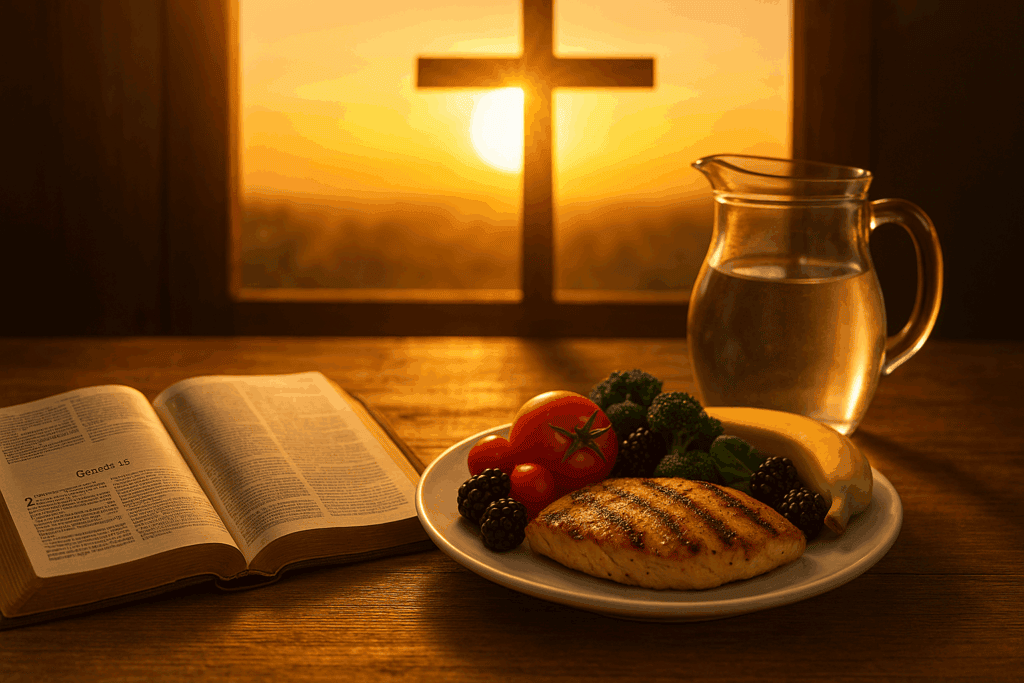
Ask most men what they’re cutting to lose weight, and vegetables rarely make the list. They should be the first thing you’re adding, not the last thing you’re avoiding.
The best vegetables for weight loss are non-starchy, high-fiber, and low in calorie density — broccoli, spinach, kale, Brussels sprouts, and cauliflower lead the list. A 24-year cohort study found non-starchy vegetables were linked to less weight gain over time, while starchy vegetables like potatoes, corn, and peas moved the opposite direction. Genesis 1:29-30 already named “every green plant” as food for both people and animals; the research simply confirms which ones do the most work.
What Genesis 1:29-30 Says About Vegetables
Genesis 1:29 gives Adam seed-bearing plants and fruit. The very next verse widens the picture: God gives “every green plant for food” to every living creature on earth (Genesis 1:30, NIV). Vegetables sit inside that category — leafy greens, roots, and the rest of what grows green and low to the ground (see Seed-Bearing Plants: The Original Diet God Gave Adam).
This wasn’t a minor food group in Scripture. When Daniel and his friends tested a vegetables-and-water diet against the king’s rich food, they came out “healthier and better nourished” after ten days (Daniel 1:12-15, NIV) — the same test referenced in the seed-bearing-plants post, and one worth remembering here too.
What the Research Actually Found
The same 24-year cohort study that tracked fruit also tracked vegetables separately by type, following over 133,000 people across three groups (PLOS Medicine, 2015). Non-starchy vegetables — leafy greens, string beans, and similar produce — were linked to measurably less weight gain over each four-year period studied.
Starchy vegetables told a different story. Corn was linked to over 2 lbs of gain per daily serving in the same data set; peas added over a pound; potatoes showed a similar pattern (Harvard T.H. Chan School of Public Health). The researchers pointed to fiber and glycemic load as the likely explanation — starchy vegetables spike blood sugar faster and fill you up less per calorie than their non-starchy counterparts.
That’s not a case against potatoes forever. It’s a case for making leafy greens and cruciferous vegetables the default, not an afterthought.
The Best Vegetables for Weight Loss, Ranked by Fiber
Fiber-per-calorie is the number that matters most here — it’s what makes a vegetable filling instead of forgettable.
| Vegetable | Serving | Calories | Fiber |
|---|---|---|---|
| Broccoli | ½ cup | 15 | 2g |
| Cauliflower | ¾ cup | 15 | 2g |
| Spinach | ⅔ cup | 35 | 4g |
| Kale | 100g | 49 | 4g |
| Brussels sprouts | ⅔ cup | 35 | 3g |
| Eggplant | 100g | 45 | 3g |
| Carrots | 1 medium (7″) | 30 | 2g |
(Figures from Eat This, Not That, citing dietitian Chris Mohr, PhD, RD.)
Every vegetable on that list delivers real fiber for under 50 calories a serving — which is exactly the math that makes a plate feel full without running up the total.
Notice that four of the seven — broccoli, cauliflower, Brussels sprouts, and kale — are cruciferous vegetables. Beyond fiber, a large research review found cruciferous vegetable intake was associated with reduced risk of cardiovascular disease and total mortality (PMC / American Journal of Clinical Nutrition). That’s not a weight-loss number specifically, but it’s a reason to treat this category as more than a means to a smaller waistline.
Why Volume Matters as Much as Fiber
Nutrition researcher Barbara Rolls built an entire framework, Volumetrics, around one idea: foods with low calorie density let you eat a larger volume for the same number of calories (Cleveland Clinic). Non-starchy vegetables sit at the bottom of that calorie-density scale — mostly water and fiber by weight.
Practically, that means a plate piled with broccoli and spinach can be genuinely large and still land under 100 calories. Your stomach registers volume, not just calorie count, when it signals “full” — so bulking up a meal with vegetables is one of the most direct ways to eat less without white-knuckling portion sizes.
This is also the simplest fix for the “I’m still hungry after a healthy meal” problem. A grilled chicken breast and a small scoop of rice can leave you scanning the pantry an hour later. The same plate with two cups of roasted vegetables added rarely does — not because the vegetables are magic, but because volume and fiber both slow down how fast a meal empties out of your stomach.
Starchy vs. Non-Starchy: Not All Vegetables Are Equal
“Eat your vegetables” isn’t specific enough advice on its own. Potatoes, corn, and peas are still vegetables — they’re just built differently, with more starch and less water than broccoli or spinach.
None of this makes starchy vegetables sinful or off-limits; Scripture never draws that line, and neither should you. It just means they shouldn’t be your default when weight loss is the goal. Save the potatoes for the meal where they’re the point, and build most other plates around the non-starchy list above.
A simple rule of thumb: if it grows underground and stores well through winter (potatoes, corn, winter squash), treat it as a starch. If it’s a leaf, a stalk, or a stem — spinach, broccoli, celery, peppers — it’s almost certainly on the non-starchy side, and you can eat more of it without doing the math.
When the Israelites Missed Their Vegetables
Here’s a detail worth sitting with: when the Israelites complained in the wilderness, they weren’t craving dessert. They were craving vegetables. “We remember the fish we ate in Egypt at no cost — also the cucumbers, melons, leeks, onions and garlic” (Numbers 11:5, NIV). God was feeding them manna from heaven, and they were homesick for produce.
That’s a strange thing to miss if vegetables were ever meant to feel like punishment. Scripture treats a plate of cucumbers and onions as something worth longing for, not something to choke down out of obligation. If an entire nation wandering the desert remembered garlic and leeks fondly enough to complain about losing them, the “vegetables are a chore” framing says more about modern cooking habits than it does about the vegetables themselves.
“A Meal of Vegetables With Love” — Answering the Boring Objection
If your honest reaction to vegetables is “I know they’re good for me, but they’re boring,” Proverbs has already addressed it — just not the way you’d expect. “Better a small serving of vegetables with love than a fattened calf with hatred” (Proverbs 15:17, NIV).
The proverb isn’t ranking vegetables against meat on flavor. It’s making a point about what surrounds the meal — that a simple plate shared in peace beats a lavish one soaked in conflict. But it also assumes vegetables belong on a table worth sitting at, not a plate you tolerate.
Vegetables cooked with care — real seasoning, roasted instead of boiled, olive oil instead of nothing — aren’t the same as a sad, unsalted side dish. If vegetables feel boring on your plate right now, that’s usually a preparation problem, not a vegetable problem.
How Vegetables Fit Into the Holy Diet
Vegetables are one of the five categories in the original diet from Genesis 1:29 — alongside fruit, legumes, nuts, and seeds (see Best Fruits for Weight Loss, Seed-Bearing Plants, and The Holy Diet). Build meals around the non-starchy list above, season them like they matter, and treat starchy vegetables as an occasional addition rather than the base.
Why listen to me on this: I’m a certified personal trainer with nutrition and functional training certifications, and I’ve spent over a decade in the fitness industry building nutrition frameworks — including the Holy Diet and Temple Training system — directly from Genesis 1:29 and current research.
If you want a structured way to put this into practice, start with the Kingdom Reset 5-Day Fast — free inside the Kingdom Gladiators Skool community. It’s the on-ramp most people use before building a full Holy Diet meal plan around foods like these.