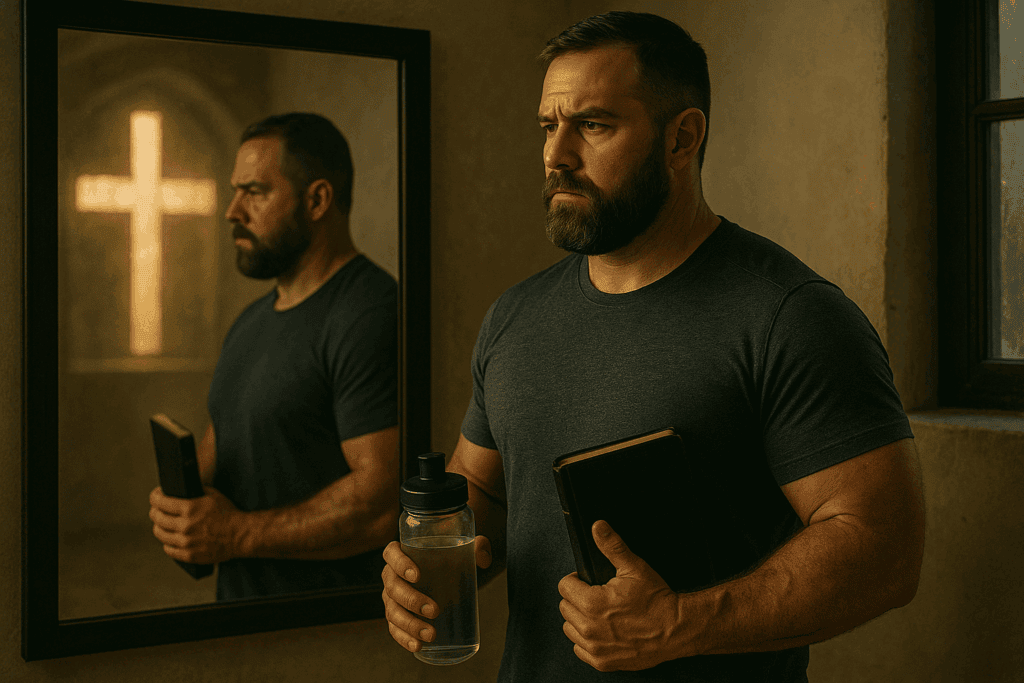
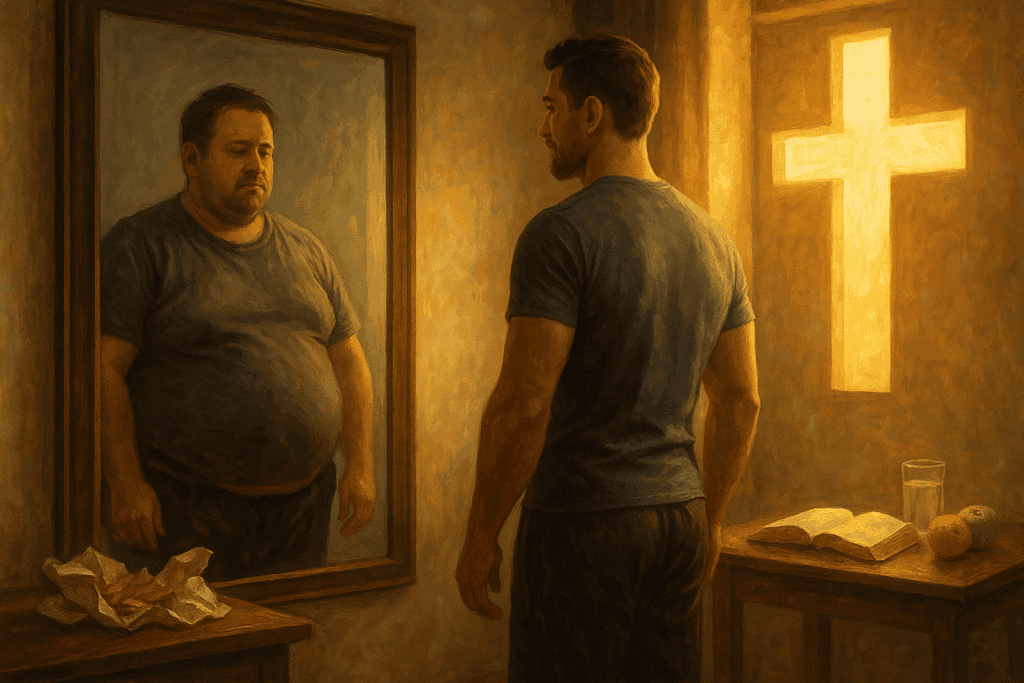
A man scrolls past a coworker’s promotion announcement and feels something in his chest tighten. A father stares at the same number on the scale on a Monday morning. It’s the fifth Monday in a row. A husband replays a mistake from ten years ago that his wife stopped bringing up long before he did. Each one is quietly asking the same question: is this what I actually am?
Your new identity in Christ is not something you build through performance. It is not erased by failure either — it is a fixed identity God gave you the moment you trusted Him. Scripture names it in specific terms. You are a new creation (2 Corinthians 5:17). You carry full inheritance rights as a son of God (Romans 8:14-17). And you were chosen, before the foundation of the world (Ephesians 1:4). Culture measures you by your career, your body, and your achievements. God measures you by what Christ already did. Your worst day and your best day change nothing about your standing before Him. Below is what these identity texts actually mean, why performance-based identity always collapses, and four practical steps for anchoring your identity in something that doesn’t.
Whose Voice Gets to Define You?
Every man is being defined by someone, all the time, whether he notices it or not. Culture defines him by output — what he earns, how he looks, what he’s accomplished by a certain age. Failure defines him by the worst thing he’s done. It replays on a loop long after everyone else has forgotten it. His past defines him by the guy he used to be. It treats that old guy as the real one, and the change since then as just performance.
Those voices don’t agree with each other, and none of them are stable. Culture’s definition changes with the market and the mirror. Failure’s definition never lets him finish paying for the same debt twice. His past’s definition assumes he can’t actually change, no matter how long he’s walked a different direction.
Scripture offers a fourth voice, and it doesn’t compete on the same terms. It doesn’t say “you’re not that bad” or “focus on the positives.” It says something more specific. The identity culture, failure, and your past keep arguing over was already settled. It was settled by someone with the authority to settle it, the moment you trusted Christ. That’s not a mood or a mindset trick. It’s a legal and relational fact, and the rest of this post walks through exactly what it means.
You Are a New Creation — What 2 Corinthians 5:17 Actually Means
Paul writes it plainly: “Therefore, if anyone is in Christ, the new creation has come: The old has gone, the new is here!” (2 Corinthians 5:17, NIV). It’s easy to read that as a nice sentiment about a fresh start. The Greek underneath it is more specific.
The word translated “new” is kainos. That’s not the more common Greek word for “new,” the one that just means new in time — like a new phone replacing an old one. Kainos means new in kind, not new in sequence. Nineteenth-century scholar R.C. Trench drew the same distinction: something with a different quality than what came before, not just a later version of the same thing (Precept Austin).
That distinction matters. Paul isn’t saying a believer gets a slightly improved version of his old self, the way a gym membership improves a man’s body without changing what kind of thing he is. The old self — the one culture, failure, and the past keep appealing to — is gone. Not touched up. Gone. Commentator Adam Clarke described it as a life that “was in chaotic disorder” being brought into order by God’s own workmanship, the same kind of creative act as the original creation, though not the same scale (Precept Austin).
This isn’t just a label with no bearing on real life. It also isn’t a claim that a believer stops sinning the moment he’s saved. It’s a new status before God, and it’s the start of an actual, ongoing transformation. Desires, hopes, the whole direction of a life — reoriented at the root. The old identity a man keeps defending or apologizing for isn’t the real one anymore. It’s the one that got replaced.
You Are a Son of God — What Adoption Actually Meant in Paul’s World
“Yet to all who did receive him, to those who believed in his name, he gave the right to become children of God” (John 1:12, NIV). Paul goes further in Romans: “The Spirit you received does not make you slaves, so that you live in fear again; rather, the Spirit you received brought about your adoption to sonship. And by him we cry, ‘Abba, Father'” (Romans 8:15, NIV).
That word “adoption” — huiothesia in Greek — wasn’t a soft, sentimental idea in Paul’s world. Roman adoption was a formal legal act. It existed mainly to secure an heir, not to rescue a child in need. An adopted son didn’t get a probationary status or a lesser inheritance to prove himself with. He was legally severed from his old family and given every privilege of his new one — full name, full inheritance, full standing, no asterisk (Christian Publishing House).
Paul uses that exact legal picture on purpose. “The Spirit himself testifies with our spirit that we are God’s children. Now if we are children, then we are heirs” — heirs of God, co-heirs with Christ (Romans 8:16-17, NIV). Galatians 4:4-7 makes the same case. God sent His Son “to redeem those under the law, that we might receive adoption to sonship.” A believer is no longer a slave, but God’s child, and an heir because of it.
A slave’s standing depends on ongoing performance. A son’s standing doesn’t. It was settled the moment the adoption became legal, and nothing that happens afterward reopens the question. That’s the category scripture puts a believer in. Not probation. Sonship.
You Are Chosen — Not an Accident, Not a Consolation Prize
“For he chose us in him before the creation of the world to be holy and blameless in his sight” (Ephesians 1:4, NIV). Before the world existed, before anything a person would go on to do or fail to do, God had already chosen him. Peter uses even bolder language for the whole church: “you are a chosen people, a royal priesthood, a holy nation, God’s special possession” (1 Peter 2:9, NIV). Paul tells the Colossians the same thing plainly — “God’s chosen people, holy and dearly loved” (Colossians 3:12, NIV).
Bible scholars debate exactly how individual and corporate election relate to each other. Some argue God’s choice lands first on the church as a body, and individuals are included by being united to it. Others argue the choosing is aimed at specific people from the start. That’s a real, long-running theological conversation, and this post isn’t the place to settle it (Ligonier).
What both sides agree on matters more here. However the mechanics work, the choosing happened before the foundation of the world. It was based on God’s own purpose, not a performance review God ran on a person’s life first. Ligonier’s devotional on this passage puts it directly: the choice “rests entirely on God’s sovereign choice, not human merit” (Ligonier). A believer’s honest posture in response is gratitude for something he didn’t earn and couldn’t have.
That timing wrecks the idea that a man got picked because he was impressive enough to notice. He wasn’t. He was chosen before there was anything to notice. Chosen isn’t a participation trophy. It’s the opposite of one — a real selection, made before he existed, that had nothing to do with his stats.
Why Performance-Based Identity Always Collapses
Here’s the trap most men fall into without naming it. They know these verses exist. They still run their actual sense of self off career, body, and achievement. Psychologists Jennifer Crocker and Connie Wolfe studied exactly this pattern and published the results in Psychological Review in 2001. They identified seven common domains people build self-worth on: appearance, others’ approval, competition, academic or professional competence, family support, virtue, and God’s love (Crocker & Wolfe, 2001).
Their finding on the external domains matters most here — approval, appearance, competition, achievement. People whose self-worth rides on those domains show real emotional volatility. A win produces a genuine spike in self-esteem. A loss produces a disproportionate crash. Over time, external contingencies like these predict higher rates of depression. Internal domains like virtue held up better (Crocker & Wolfe, 2001).
There’s a sharper finding underneath that one. Students who staked their self-worth on academic performance didn’t just feel worse after a bad grade. They studied more hours than other students and still didn’t improve their GPA. The goal had quietly shifted from learning to protecting an identity (Crocker & Wolfe, 2001). Chasing the outcome to prove something about himself made the outcome harder to reach, not easier.
Career, Body, Achievement: Same Trap, Three Flavors
This is the exact mechanism behind a man’s career, his body, and his achievements collapsing as an identity foundation. Career identity falls apart at a layoff, a bad review, or the day a younger guy gets the promotion instead. Body identity falls apart the first time the mirror or the scale disagrees with him — which for most men is often. Achievement identity never actually settles. There’s always a next benchmark demanding to be cleared before he’s allowed to rest.
Even the “God’s love” domain in Crocker and Wolfe’s list can quietly become another performance contingency. That happens when what’s actually being tracked is a man’s own spiritual performance — his quiet time streak, his ability to feel close to God that week. That’s not the same as an identity already secured by what Christ did. One is graded daily. The other was graded once, at the cross, and the verdict doesn’t move.
When Your Past Won’t Let Go: Peter’s Restoration
If any biblical figure had grounds to let his past define him, it was Peter. He denied knowing Jesus three times in one night. The third time, he did it with a curse, standing near a charcoal fire in the high priest’s courtyard (Luke 22:54-62; John 18:18). Peter wasn’t a stranger failing under pressure. He was the disciple who’d promised, hours earlier, that he’d die before he denied Christ.
The resurrected Jesus finds Peter later. John records the setting with a specific detail: another charcoal fire (John 21:9). The Greek word for “charcoal fire,” anthrakia, appears in only these two places in the entire New Testament — the denial and the restoration. That’s not likely a coincidence. Jesus brings Peter back to the same kind of scene where he failed. He asks him the same question three times, “Do you love me?” — matching Peter’s three denials one for one (John 21:15-17).
Jesus doesn’t extract a confession of guilt before restoring Peter. He doesn’t hand him a probationary status to work off either. He gives him a job: “Feed my sheep.” The man who denied Christ three times became the man who preached the sermon at Pentecost. Three thousand people came to faith in a single day because of it (Acts 2:41). Scripture doesn’t record Peter earning his way back into standing through a season of proving himself. It records Jesus meeting him at the site of his worst failure and handing him a future anyway.
That’s the pattern a man’s own past failure has to reckon with. His past doesn’t get veto power over what God has already decided to do with him. Neither did Peter’s.
Holding Your Identity When Everything Else Was Stripped Away
German pastor and theologian Dietrich Bonhoeffer wrote a poem titled “Who Am I?” in a Nazi prison cell in Tegel, in 1944, months before his execution. It later appeared in his book Letters and Papers from Prison. The poem describes how the other prisoners and guards saw him: calm, cheerful, steady, like “a squire from his country house.” Then it turns inward. It admits what he actually felt underneath that composure — restless, anxious, trembling with rage at injustice, starving for color and for words like a man starving for food.
Bonhoeffer names the gap directly. Is he the calm man others see, or the anxious man he feels like inside? He doesn’t resolve it by picking one version as the “real” him. The poem ends by handing the whole question to God. Whichever one is real, he belongs to God either way.
Everything culture normally uses to build a man’s identity had been stripped from Bonhoeffer — his freedom, his career, his reputation, his future. What was left wasn’t a feeling he’d successfully manufactured. It was a fact he was choosing to stand on regardless of what he felt that day. That’s the same move this post is asking of the man whose identity took a hit this week, just without a prison cell attached to it.
Old Identity Narrative vs. New Identity in Christ
| What Culture, Failure, or Your Past Say | What God Says | |
|---|---|---|
| Career | You are what you produce and earn | You are God’s handiwork, created for good works (Ephesians 2:10) |
| Body | You are how you look right now | You are a temple of the Holy Spirit (1 Corinthians 6:19-20) |
| Achievement | You are your last win or your last loss | You are already accepted in Christ, apart from performance (Ephesians 1:6) |
| Past failure | You are the worst thing you’ve done | You are a new creation; the old has gone (2 Corinthians 5:17) |
| Standing before God | Something you have to earn or maintain | Something already settled through adoption (Romans 8:15-17) |
| Selection | Something you have to prove you deserve | Something decided before the foundation of the world (Ephesians 1:4) |
Four Steps for Anchoring an Identity That Doesn’t Collapse
1. Catch the old sentence before you finish it
Culture, failure, and your past all speak in short, automatic lines — “you’re a failure,” “you’re behind,” “you’ll always be this way.” Most men never interrupt these thoughts. They just accept the verdict and move on with their day. Naming the sentence the moment it shows up is the first step to replacing it — a discipline explored further in Self-Talk: What the Bible and Neuroscience Say.
2. Renew your mind on purpose, not by accident
“Do not conform to the pattern of this world, but be transformed by the renewing of your mind” (Romans 12:2, NIV). That renewal doesn’t happen automatically just because a man believes the right things in theory. Pick four or five identity verses from this post. Put them somewhere he’ll actually see them. Review them on a set day each week — not just once, after reading an article like this one.
3. Remember what your baptism marked, not just what you feel today
“All of us who were baptized into Christ Jesus were baptized into his death” (Romans 6:3, NIV). “All of you who were baptized into Christ have clothed yourselves with Christ” (Galatians 3:27, NIV). Baptism isn’t a ceremony that made a man a slightly better version of himself. It marks a specific point where his old identity was buried and a new one began. On days his feelings don’t match that fact, the fact is still the fact.
4. Let your identity get reinforced by people who know your story
“Let us consider how we may spur one another on toward love and good deeds, not giving up meeting together” (Hebrews 10:24-25, NIV). An identity claimed alone, in private, tends to erode under pressure. An identity spoken back to a man by other believers who know what he’s actually walked through holds up longer. That’s part of why the Kingdom Gladiators community exists — not to add another performance metric, but to have other men say the true thing back to him on the days he can’t say it to himself.
Common Objections (And Why They Don’t Hold Up)
“Isn’t this just self-esteem talk with Bible verses stapled on?” No — the difference is where the worth originates. Self-esteem culture tells a man to generate his own sense of worth from inside himself, on repeat, whether or not anything backs it up. Scripture tells him his worth was assigned from outside himself, by God, based on what Christ did. That’s a fact that doesn’t depend on how convincingly he says it to the mirror.
“If my identity is already secure, why does my behavior still need to change?” Because identity in Christ was never framed as an excuse to stop there. Right after Paul writes “the new creation has come,” he keeps going. God has given believers “the ministry of reconciliation” (2 Corinthians 5:18) — an assignment, not just a status update. Secure identity is the foundation transformation gets built on, not a replacement for building it. James makes the same point from a different angle: real faith always produces real action (James 2:17).
“What if I don’t feel like a new creation most days?” Feelings were never the test of whether something is true. A married man doesn’t stop being married on the days he doesn’t feel particularly close to his wife. The Crocker and Wolfe research above shows exactly why chasing a feeling as proof of identity backfires. It turns a settled fact into one more performance metric to hit. The fact holds whether the feeling shows up that day or not.
A Word for the Women Reading This
Most of this post speaks to men directly, since most of the men who need to hear it won’t go looking for it on their own. About one in five readers here is a woman. She’s often searching on behalf of a husband or son caught in the gap between what he believes and how he actually sees himself.
Everything above applies to her the same way it applies to him. Adoption, chosenness, and new creation aren’t identity categories reserved for one gender. If she’s watching a man she loves define himself by his job title or his worst mistake, these are the texts worth putting in front of him. Not as a lecture — as a truer story than the one he’s currently telling himself.
How This Connects to the Rest of the System
This post is a close cousin to Self-Talk: What the Bible and Neuroscience Say and Christian Positive Thinking: Biblical Hope vs. Manifestation Culture. Those posts deal with the words a man says to himself, and what he’s trusting to change his circumstances. This one deals with something underneath both — who he actually believes he is before he ever opens his mouth.
That question sits directly under the gap How to Lose Weight as a Christian names as the real barrier for most men in this community: he knows what’s true, and he doesn’t live like it yet. A man who’s still secretly defining himself by his body will treat every setback on the scale as proof of who he really is, and quit. A man whose identity is already settled in Christ can take the same setback as information, not a verdict, and keep going. Treating Your Body as a Temple only makes sense once a man believes he’s worth stewarding in the first place. That belief starts here.
Why Listen to Me
I’ve spent more than a decade in the fitness industry as a certified personal trainer, with nutrition and functional training certifications. That’s included years as a big-box gym manager and overseeing multiple group fitness franchises. What I’ve watched, over and over, is men trying to out-discipline a shame they never actually resolved — and burning out doing it. The Holy Diet and Temple Training system starts with a settled identity, not a performance to maintain, because the second one never holds up under real pressure.
You can read more on the About page or reach out through the Contact page.
Where to Start
Your career can be taken from you. Your body will keep changing whether you like it or not. And your past already happened — it can’t be edited. None of those were ever meant to hold the weight of telling you who you are. The fact that you’ve been asking them to is probably why the answer keeps shifting under your feet.
The Kingdom Reset is a free, five-day water-only fast inside the Kingdom Gladiators community on Skool. It’s not a test to pass to earn a new identity. It’s a chance to practice living like the one you’ve already been given.