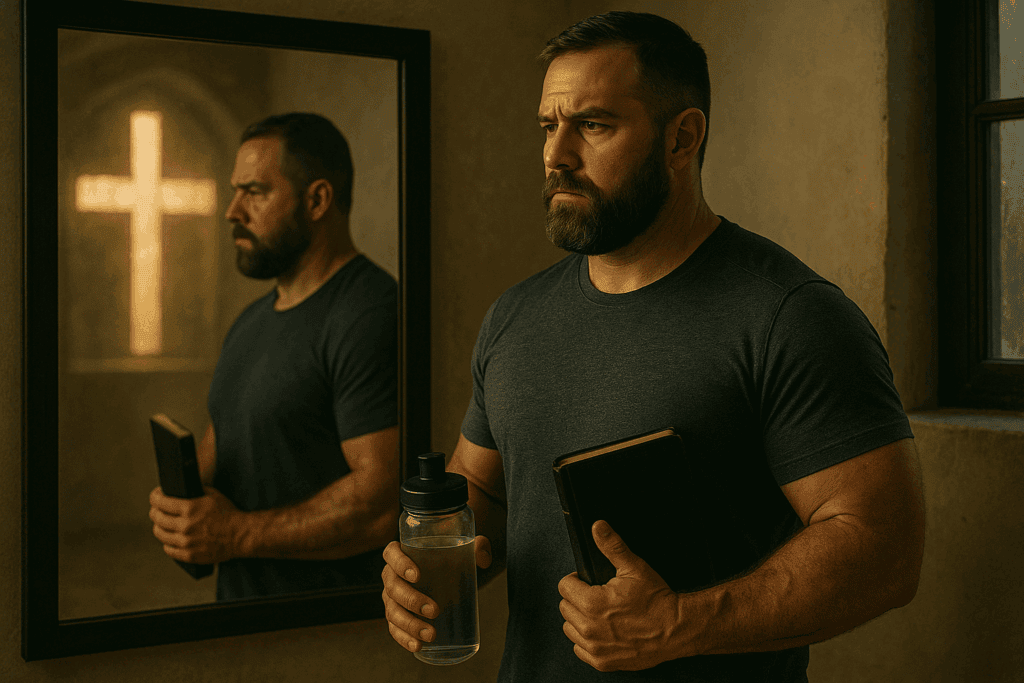
A man opens Instagram and sees a quote card: speak it into existence. He’s heard a version of this in church too — name it and claim it, believe it and receive it. Both promise the same thing: think the right thoughts, say the right words, and reality bends to match them.
Christian positive thinking is not the same thing as biblical hope. Confusing the two leads a lot of Christians into manifestation culture wearing a cross. Others end up in denial dressed up as faith. Biblical hope is confident expectation grounded in who God is and what He has already done. It isn’t a mental technique for manufacturing a desired outcome. Philippians 4:8 does give a real, practical filter for what to think about. But it’s a filter for truth, not a formula for positivity. Below is what separates the two. A bestselling Christian author blurred the line between them seventy years ago. This post also gives a practical way to renew your mind without lying to yourself about what’s actually true.
What Positive Thinking Culture Actually Teaches
“Positive thinking” as a self-help category makes one core claim: your thoughts shape your reality, so control the thoughts and you control the outcome. Manifestation and the Law of Attraction push that claim further. They teach that focused thought and feeling pull matching circumstances toward you, almost like a physical law. Speak it, believe it, feel it as already true — and the universe supposedly rearranges itself to deliver it.
Some Christian content quietly adopts this same mechanism and drops a Bible verse on top of it. Say it in faith and God has to move. Believe it and He’s obligated to deliver. That’s not a small rewording of Christian doctrine — it relocates the power. In genuine Christian faith, God moves according to His will and His character. A Christian trusts Him, not a technique. Manifestation logic works differently. The power sits in the thinker’s own mind and words. God — or “the universe” — just becomes the delivery mechanism for whatever the thinker decided to want.
One Christian analysis of the Law of Attraction lays out the theological problem plainly. It “ascribes God’s power to the physical universe.” It assumes blessing follows correct thinking rather than righteous living, and it ignores that God has a larger plan that may not include everything a person wants (Life, Hope & Truth). That’s the real fault line. Not “does positive thinking feel nice” — it does. It’s “who’s actually in control, and is the goal godliness or getting what you asked for.”
What Biblical Hope Actually Is
Scripture uses a specific word for hope — the Greek elpis. It doesn’t mean what casual English “I hope so” means. Classical Greek let elpis point either good or bad, an open expectation either way. The New Testament narrows it. Elpis becomes confident expectation of what is certain, anchored to God’s character and secured by what Christ already did (BibleHub, Strong’s 1680). It isn’t measured by how convincingly a person can picture the outcome they want.
Romans 5:3-5 makes the source of that confidence explicit: “suffering produces perseverance; perseverance, character; and character, hope… because God’s love has been poured out into our hearts through the Holy Spirit” (NIV). Notice the order. Hope shows up on the far side of suffering, not as a way to avoid it. Manifestation culture treats hardship as a mindset failure to correct. Paul treats it as the path hope actually grows through.
Hebrews 11:1 defines faith as “confidence in what we hope for and assurance about what we do not see” (NIV). That’s confidence rooted in who’s making the promise, not in how vividly someone pictured the outcome.
Romans 15:13 calls God Himself “the God of hope,” who fills believers with joy and peace as they trust Him, “so that you may overflow with hope by the power of the Holy Spirit” (NIV). Hope is something God supplies, not something generated by repetition.
Abraham shows what this looks like under real pressure. At a hundred years old, with his wife’s womb long past bearing children, he “against all hope, in hope believed” he’d father many nations (Romans 4:18). His hope stood on God’s specific promise — not on his ability to picture grandchildren clearly enough to summon them.
The Most Misused “Positive Thinking” Verse: Jeremiah 29:11
If one verse gets stretched to do manifestation’s work more than any other, it’s Jeremiah 29:11: “For I know the plans I have for you,” declares the Lord, “plans to prosper you and not to harm you, plans to give you hope and a future” (NIV). It shows up on graduation cards and motivational posts as a blanket personal promise. Believe hard enough, and God’s got your specific outcome waiting.
Read the verse where it actually sits and a different picture appears. Jeremiah wrote this to Jewish exiles deported to Babylon after their nation had just been crushed militarily. God doesn’t promise quick rescue. He tells them, through Jeremiah, to build houses, plant gardens, and settle in for seventy years before restoration comes (BibleProject). It’s a corporate promise to a specific, suffering community about a long, hard road. It isn’t a guarantee that a Christian’s individual plans will materialize on his timeline just because he believed hard enough.
That doesn’t make the verse useless. It still says something true about God’s character. He hadn’t abandoned people in exile, and His plans for them were ultimately for their good, not their harm. That’s worth trusting. It’s just not a mechanism for getting a specific outcome by believing it into being. The exiles didn’t manifest their way home early. They waited, most of them for the rest of their lives, trusting a God who kept His word on His timeline.
The Book That Blurred the Line: Norman Vincent Peale
Norman Vincent Peale published The Power of Positive Thinking in 1952. It sold over 5 million copies and spent 186 weeks on the New York Times bestseller list — 48 of them at number one. It’s been translated into more than 40 languages (Wikipedia, The Power of Positive Thinking). No Christian self-help book before or since has reached that scale of influence. A huge amount of “Christian positive thinking” content in circulation today traces back to Peale, directly or indirectly.
Peale opens the book with “believe in yourself.” The whole system builds from there: affirmation, visualization, and what he called “prayerization.” He taught readers to repeat statements like “I can do all things through Christ which strengtheneth me” ten times daily. Telling them to picture themselves succeeding. To treat prayer as, in his words, “the greatest energy in the universe.” Some of that lines up with real biblical practice. Some of it doesn’t. The difference matters more than most readers realize.
Peale didn’t build this system from scripture alone. He drew heavily on the New Thought movement — the same intellectual tradition behind Christian Science and Science of Mind. Its core idea: mind is the primary reality shaping circumstance (Big Think). That’s not a minor footnote about where an idea came from. New Thought’s core claim — that focused belief itself generates outcomes — is functionally the same mechanism manifestation culture runs on today. Peale wrapped it in Bible verses and delivered it from a Manhattan pulpit, but the engine underneath wasn’t purely biblical.
What Peale Got Right — And Where His Theology Drifted
Give credit where it’s earned. A man’s habitual thoughts shape his outlook, stress level, and behavior. Repeating scripture on purpose changes something real. Despair and self-defeating thinking are genuine problems worth confronting, not ignoring.
Where he drifted matters just as much, and serious theologians said so at the time, not just in hindsight. Reinhold Niebuhr, the leading American theologian of Peale’s era, said Peale’s teaching corrupted the gospel — it “hurts people too… helps them feel good while they are evading the real issues of life” (NPR, 2020). Episcopal theologian John Krumm was more specific. Peale, he wrote, “reduced God to a force and made Christianity self-centered rather than God-centered.” “Very little is said about the sovereign mind and purpose of God,” Krumm added. “Much is made of the things men can say to themselves” (Challies).
That’s the exact drift this post warns against. Peale himself said, “God is vitality. God is life. God is energy” — language that treats God as a power source to tap into, not a sovereign being to submit to (Challies). Critics also noted the book had no real theology of suffering (Big Think): no framework for a believer facing grief, or a diagnosis that isn’t reversing no matter how positively he thinks about it. Biblical hope has one. Job’s friends tried to talk him into a positive-thinking framework, and God rebuked them for it (Job 42:7).
The techniques aren’t the problem. Scripture actually endorses some form of affirmation, visualization, and prayer. The real question is what a man affirms, what he pictures, and who he believes is in control. Get that right, and Peale’s tools become useful again.
Philippians 4:8: Paul’s Actual Filter
This is the verse most often cited to justify “Christian positive thinking.” It’s worth reading slowly instead of skimming for the word “positive” — which doesn’t appear in it at all: “Finally, brothers and sisters, whatever is true, whatever is noble, whatever is right, whatever is pure, whatever is lovely, whatever is admirable — if anything is excellent or praiseworthy — think about such things” (NIV).
Paul isn’t handing readers a mood. He’s handing them a filter with eight specific tests, and the first one is decisive: true. Not encouraging. Not comfortable. True. A thought has to clear that bar before the other seven even apply. That single word rules out most of what manifestation culture asks a person to think. Vivid pictures of outcomes that haven’t happened and aren’t promised — spoken as if they’re already settled fact — simply don’t clear it.
One study resource on this passage puts the distinction well: this “isn’t merely about optimistic thinking.” Paul is directing believers to “focus our lives on things that please God.” That’s a deliberate, active practice of dwelling on God-honoring content (BibleRef). It’s paired with a reminder just before it: God Himself guards a believer’s heart and mind (Philippians 4:7), even as the believer does his part. It’s reciprocal. God does the guarding. The believer does the choosing of what gets rehearsed.
This is where “Christian positive thinking” done right and manifestation done with Bible verses attached permanently split. One asks “is this true,” first, before anything else. The other asks “does this feel good, and can I believe it hard enough to make it happen.” Those are different questions with different answers most of the time.
Where “Positive Thinking” Becomes Denial
There’s a second failure mode on the opposite side from manifestation. It’s just as common in church culture: using positivity to avoid a true, hard thing instead of facing it. Psychologists call this toxic positivity: “the act of avoiding, suppressing, or rejecting negative emotions or experiences” in favor of forced cheerfulness (Psychology Today). A man loses his job. He’s told “everything happens for a reason” before he’s allowed to say out loud that it hurts. A grieving widow hears “she’s in a better place,” instead of finding someone willing to sit with her in the actual loss.
Research backs up why this backfires. Suppressing a real emotion instead of processing it tends to “breed guilt, shame, sadness, and anxiety.” It can magnify the very feeling it’s trying to bury, rather than resolving it (Psychology Today). Positive reframing helps in situations genuinely outside a person’s control. It tends to hurt when it’s used to avoid dealing with something that’s actually true and needs to be faced.
This is exactly why “true” has to come before “positive” in Philippians 4:8, not after it. A man who just lost his job and thinks “I’m worthless” is thinking something false — that fails the filter immediately. A man who thinks “I lost my job and this is genuinely hard right now” is thinking something true, even though it isn’t cheerful. Paul’s filter doesn’t ask him to skip that thought. It asks him not to camp there permanently. Let true grief sit alongside true hope, instead of forcing one to cancel out the other.
Turning Affirmation Into Truth-Telling
Peale had readers repeat self-selected statements, mostly aimed at boosting confidence. The Philippians 4:8 version of affirmation works differently in one specific way: the content isn’t self-generated. It’s declared, and it comes from outside the man saying it.
Scripture already states specific things that are true about a believer, whether or not he feels them on a given Tuesday. He’s a new creation (2 Corinthians 5:17). There’s no condemnation waiting for him (Romans 8:1). God’s power works through him even in weakness (2 Corinthians 12:9). Speaking those out loud isn’t manufacturing a belief through repetition and hoping it becomes true through sheer volume. It’s rehearsing something God already said, on purpose. Repeat it until it’s as familiar as the false things a man has probably been rehearsing about himself for years without noticing.
The difference sounds small and isn’t. “I am confident and successful” is a claim a man is making about himself, hoping enough repetition makes it stick. “I am God’s handiwork, created in Christ Jesus to do good works” (Ephesians 2:10, NIV) is a claim God already made about him. One is self-persuasion. The other is agreement with a fact that doesn’t depend on how convincingly he says it.
Turning Visualization Into Something That Actually Works
Peale told readers to picture themselves succeeding, treating the mental image as a preview of what was coming. Modern research tells a more complicated story.
Psychologist Gabriele Oettingen has spent decades studying what happens when people vividly imagine a desired future. Her findings run against the popular assumption. In one study, students who only imagined a positive upcoming week reported lower energy right afterward. They also accomplished less over the following week than students who thought about it more realistically. In another, students practiced “mental contrasting” — picturing the goal, then honestly naming the obstacle in the way. That group tried harder and achieved more, by independent teacher reports, than students who simply indulged in the fantasy alone (Greater Good Science Center, UC Berkeley). Her explanation: a vivid fantasy can make the brain respond almost like it already happened. That quietly drains the motivation needed to make it happen for real.
Oettingen built a method around this called WOOP: Wish, Outcome, Obstacle, Plan. Name the goal, name the real obstacle, build a plan (Shortform, on Rethinking Positive Thinking). James 4:13-16 warned against something similar long before Oettingen: presuming on a future outcome — “today or tomorrow we will go to such and such a city… and make a profit” — without the humility of “if it is the Lord’s will.” James doesn’t forbid planning. He forbids planning as though the outcome is secured just because it’s been pictured clearly.
A Christ-centered version borrows the honesty of mental contrasting. It adds what Oettingen’s research doesn’t reach: name the obstacle, build the plan, then hold all of it open to God’s will — instead of treating the mental picture itself as a guarantee.
Building Self-Control Instead of Manufacturing Motivation
Positive thinking culture chases a feeling: confidence, motivation, certainty that things will work out. Scripture aims at something sturdier: self-control. It’s listed as fruit the Holy Spirit produces in a believer — not a mood a person talks himself into (Galatians 5:22-23). Paul tells Timothy that “the Spirit God gave us does not make us timid, but gives us power, love and self-discipline” (2 Timothy 1:7, NIV).
That’s a different goal than feeling positive. A man can feel completely unmotivated and still act in self-control. Self-control was never dependent on the feeling showing up first. Motivation is a mood. Self-control is a discipline the Spirit builds over time, the same way any fruit grows — slowly, through repeated seasons. It doesn’t come from one well-worded affirmation spoken with enough conviction on a Tuesday morning.
This matters directly for a man trying to close the gap between what he believes about his body and how he actually eats and trains. Waiting to feel motivated before taking action is positive-thinking logic. Acting in self-control regardless of the feeling is the biblical version. The Spirit builds that fruit in him whether he feels it that day or not.
Reducing Worry the Biblical Way
Philippians 4:6-7 gives the practical instruction Peale’s system gestures at without quite landing on: “Do not be anxious about anything, but in every situation, by prayer and petition, with thanksgiving, present your requests to God. And the peace of God, which transcends all understanding, will guard your hearts and your minds in Christ Jesus” (NIV). Notice the mechanism. It isn’t “think positive thoughts until the worry goes away.” It’s prayer, specific requests, and thanksgiving — three concrete actions, not a mental trick.
Research on gratitude backs up why thanksgiving specifically does real work against anxiety, not just prayer generally. A large epidemiological study of twins found thankfulness predicted significantly lower rates of major depression, generalized anxiety disorder, and phobia (Kendler et al., 2003, cited in Wood, Froh & Geraghty, 2010). A separate study had 247 participants keep a two-week gratitude diary, most of whom met the clinical criteria for generalized anxiety disorder. Their worry dropped 1.5 standard deviations compared to a waitlist group — on par with established cognitive-behavioral worry treatments (Wood, Froh & Geraghty, 2010). Multiple smaller studies found the same pattern in less severe cases: consistently lower negative affect after even brief, simple gratitude exercises.
That’s not a coincidence lining up with a 2,000-year-old instruction. It’s a modern data trail running underneath something Paul already told the Philippians to do. Thanksgiving isn’t a mood boost tacked onto prayer. It’s the specific ingredient scripture — and now research — both point to for actually reducing worry. Not papering over it with forced positivity.
Secular Positive Thinking vs. Biblical Hope
| Secular Positive Thinking / Manifestation | Biblical Hope | |
|---|---|---|
| Source of power | The thinker’s own mind, belief, or “the universe” | God’s character and Christ’s finished work |
| What’s required | Believe hard enough, feel it as already true | Trust God, regardless of whether the outcome matches what was pictured |
| View of hardship | A mindset problem to correct or avoid | The actual path hope grows through (Romans 5:3-5) |
| Guarantee | None — outcomes aren’t promised, despite the language of certainty | God’s promises are certain; the specific outcome a person wants isn’t |
| What happens when it doesn’t “work” | The thinker didn’t believe hard enough, or did it wrong | God is still trustworthy; hope was never staked on the outcome in the first place |
Peale’s Techniques, Renewed
| Peale’s Version | What’s Missing | The Renewed-Mind Version |
|---|---|---|
| Affirmation: self-selected confidence statements, repeated for effect | The content is self-generated, not scripture | Declare what God already said is true (Ephesians 2:10, Romans 8:1, 2 Corinthians 5:17) — agreement, not persuasion |
| Visualization: picture success as already real | No honest look at the obstacle; treats the mental picture as a guarantee | Mental contrasting: picture the goal, name the real obstacle, build a plan — held open to God’s will (James 4:13-16) |
| Prayerization: prayer as a force to unlock outcomes | Treats prayer as leverage on God rather than submission to Him | Prayer with specific requests and thanksgiving, aimed at peace, not a guaranteed result (Philippians 4:6-7) |
Common Objections (And Why They Don’t Hold Up)
“Isn’t this just splitting hairs? Positive thinking and biblical hope both help people feel better.” They can produce a similar feeling in the moment, which is exactly why they get confused. The difference shows up under pressure. Positive thinking collapses when the outcome doesn’t match what was pictured, because the belief was staked on getting that specific result. Biblical hope doesn’t collapse there. It was never staked on the outcome — it was staked on God, who doesn’t change based on how the story ends.
“Doesn’t the Bible say faith can move mountains? Isn’t that basically manifestation?” Matthew 17:20 is about faith directed at God’s power and God’s will, not a technique for generating a desired outcome through belief alone. The mountain moves because God moves it, not because a person’s certainty reached some threshold that forced reality to comply.
“Isn’t naming Peale’s errors just picking on a dead guy who helped millions of people?” No — it’s the same standard scripture applies to any teaching, regardless of how popular or well-intentioned it is (1 John 4:1). Peale genuinely helped people manage anxiety and low self-worth. He also taught things about God’s nature that don’t hold up next to scripture. Both are true at once, and naming the second doesn’t erase the first.
“What if I need to think positively just to get through the day right now?” Then take that honestly to Philippians 4:6-7 instead of manufacturing a feeling. Bring the actual anxiety to God in prayer, with thanksgiving mixed in. That’s not the same as forcing a smile over something true and hard. It’s the biblical alternative to both extremes — neither denial nor despair.
A Word for the Women Reading This
Most of this post speaks to men directly, since most of the men who need to hear it won’t go looking for it on their own. About one in five readers here is a woman, often searching on behalf of a husband or son caught somewhere between manifestation culture and genuine faith.
Everything above applies the same way to her. The pull toward “just believe it and it’ll happen” isn’t a men’s problem or a women’s problem. It’s a human one. Philippians 4:8’s filter and Philippians 4:6-7’s instruction on worry work exactly the same, regardless of who’s applying them.
How This Connects to the Rest of the System
This post is a close cousin to Self-Talk: What the Bible and Neuroscience Say, which covers the internal dialogue running underneath a man’s daily choices. That post asks what a man says to himself. This one asks what he’s trusting to actually change his circumstances — his own mental technique, or God.
Both point back to the same gap How to Lose Weight as a Christian names as the real barrier for most men in this community. He knows what’s true, and he doesn’t live like it yet. A man can spend years hoping a vision board or a repeated affirmation will eventually produce discipline he never had to practice. He’s going to keep being disappointed. A man who prays with thanksgiving, thinks on what’s true, and builds self-control as a fruit of the Spirit has something sturdier. It isn’t a mood he’s waiting to feel — it’s a foundation that holds up on the days motivation doesn’t show up at all. That’s the same foundation Treating Your Body as a Temple is built on.
Why Listen to Me
I’ve spent more than a decade in the fitness industry as a certified personal trainer, with nutrition and functional training certifications. I’ve worked as a big-box gym manager and overseen multiple group fitness franchises. Watched plenty of men try to talk themselves into change with affirmations and vision boards. Most of it fails the same way, because the technique was never going to produce discipline on its own. The Holy Diet and Temple Training system is built on trusting God and doing the work, not on manufacturing belief hard enough to skip it.
You can read more on the About page or reach out through the Contact page.
Where to Start
A vision board won’t fast for you, and an affirmation repeated in the mirror won’t build the self-control this actually takes. Prayer, thanksgiving, and a mind renewed by what’s true will.
The Kingdom Reset is a free, five-day water-only fast inside the Kingdom Gladiators community on Skool. Five days is enough to find out whether you’ve been trusting God, or trusting your own ability to think your way into a different life.