
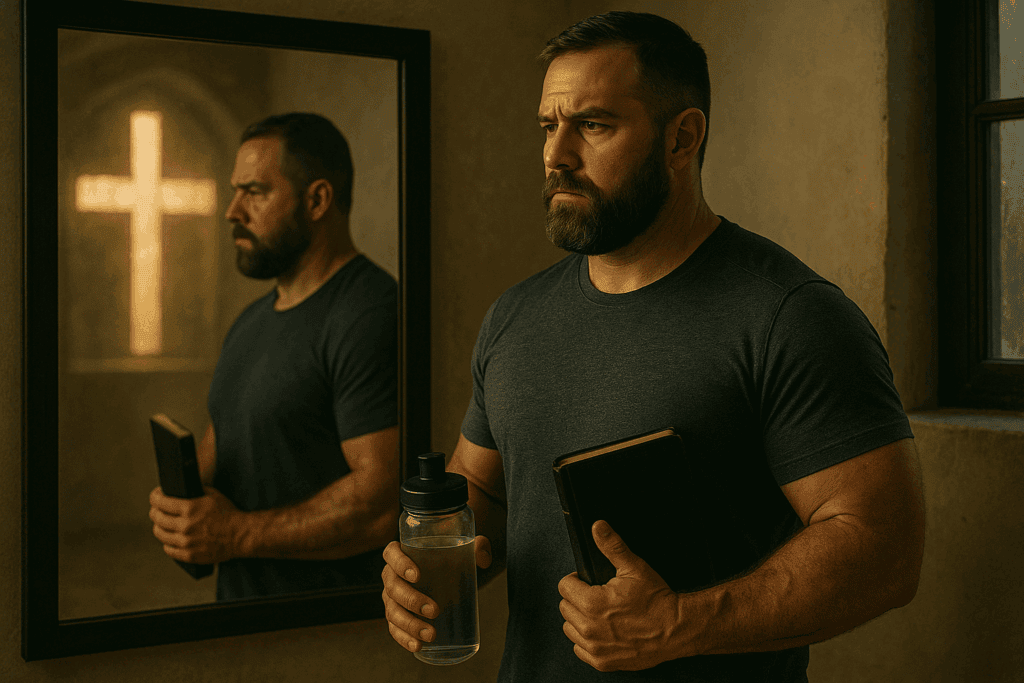
Most men treat their body like a rental car—drive it hard, skip maintenance, and expect it to keep running. But God says something different. The Bible calls your body a temple of the Holy Spirit, not a junkyard for stress, sugar, or laziness.
The Problem
A man reads 1 Corinthians 6:19 on Sunday morning and nods at the phrase “your body is a temple.” By Tuesday night, he’s eaten fast food twice and skipped both workouts he planned. That gap between what he believes and how he actually trains and eats is where most content on this verse stops short. It’s long on theology and short on what to do about it Monday morning.
Treating your body as a temple means treating what you eat, how you train, and how you rest as acts of worship and obedience to God, not a vanity project or a willpower contest. The principle comes from 1 Corinthians 6:19-20, where Paul says your body isn’t fully your own because Christ bought it and the Holy Spirit lives in it now. In practice, that means consistent stewardship: moving your body most days, training for strength, protecting your sleep, and eating according to the design God gave in Genesis 1:29. It’s not a 12-week transformation photo. The rest of this guide breaks down what that looks like week to week, and lays out the Temple Training progression built to help you live it.
What “Your Body Is a Temple” Actually Means
The verse is 1 Corinthians 6:19-20 (NIV): “Do you not know that your bodies are temples of the Holy Spirit, who is in you, whom you have received from God? You are not your own; you were bought at a price. Therefore honor God with your bodies.”
Paul wrote that specifically about sexual immorality in Corinth, not diet and exercise. A related phrase shows up a chapter earlier, in 1 Corinthians 3:16-17, but that passage is about the church as a whole, not an individual body. The two verses make a similar point in different directions — corporately and personally — but they aren’t interchangeable.
The principle underneath Paul’s specific warning still holds. A person’s body isn’t fully theirs to do with as they please. Christ bought it at a price, and it currently houses the Holy Spirit. That’s a statement about ownership, and ownership changes how a person treats something.
This isn’t a new idea Paul invented for a sermon illustration, either. Genesis 1:27 says God made man in his own image. Genesis 2:7 has him personally forming Adam from dust and breathing life into him. Your body was never a biological accident. God formed it on purpose, long before Paul ever picked up a pen to write to the Corinthians. Temple language is Paul catching up to what Genesis already established: God made this body with intention, and intention implies care.
That intention matters for the rest of this guide. Nothing here treats the body as more important than the soul it carries. It treats the body as something God built with purpose and entrusted to a person’s care — not something to starve, overwork, or leave neglected on the couch.
Why the Word “Temple” Specifically Matters
Paul didn’t reach for a random metaphor. In the Old Testament, the temple was the one place on earth where God’s presence dwelt among his people. It wasn’t decorative. Priests prepared for service in it and guarded what went in and out of it. The nation treated it as the most important physical space it had.
Paul told the Corinthians the same reality now applied to individual believers. A Christian isn’t just managing a body. He’s maintaining the place where God’s presence actually lives, right now, today.
That’s a heavier claim than most fitness writers pulling from this verse ever unpack. It’s also why “just eat healthy, no need for the biblical framing” undersells the point. The framing isn’t decoration on top of a health tip. The framing is the point, and the health habits are downstream of it.
Stewardship, Not Vanity: The Real Point of Training
Most fitness content sells a look: a better mirror, better beach photos, a better answer to “so what do you do to stay in shape.” None of that is evil. None of it is the point, either.
Romans 12:1 frames the alternative: “offer your bodies as a living sacrifice, holy and pleasing to God.” Paul calls that “true and proper worship.” Training becomes an act of worship instead of a beauty contest. Secular fitness culture trains a person for an audience. Temple stewardship trains a person for a mission.
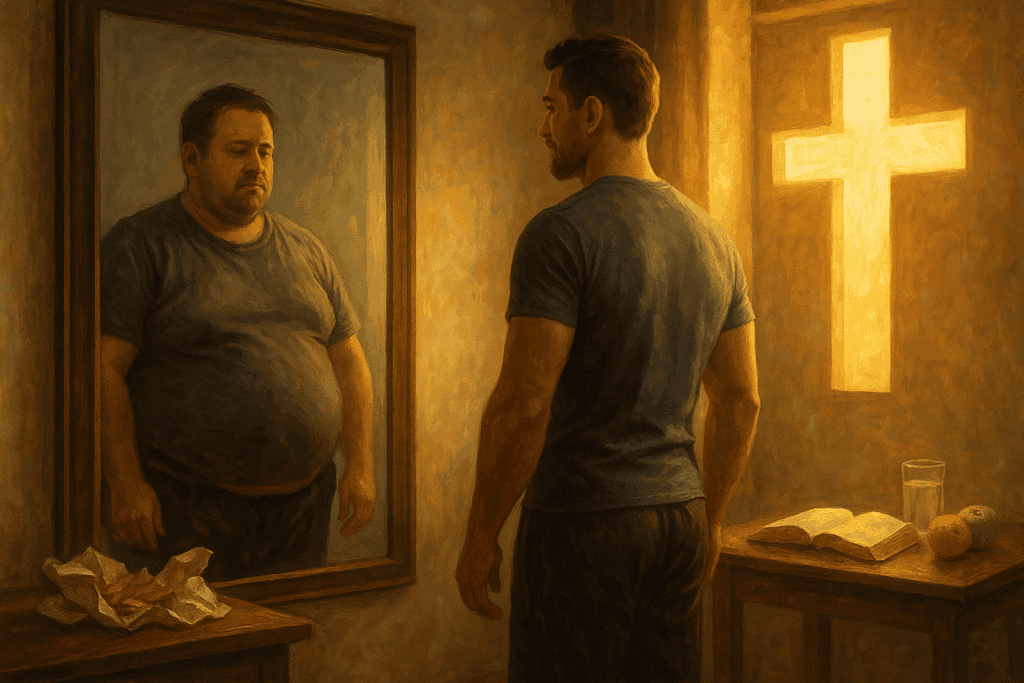
Picture two men training hard for six months, as an illustration of the difference. One chases a look — he wants people to notice when he walks into a room. The other chases capacity: energy to chase his kids around the yard at 55, and enough left over to serve at church on a Saturday instead of collapsing on the couch. Both men might end up looking similar in the mirror. Only one has a reason to keep going once the compliments stop.
Secular fitness culture sells optimization for its own sake — more reps, better numbers, a body built for strangers on a screen. That’s not nothing, but it’s a hollow finish line. It has no answer for why a man keeps going once nobody’s watching.
Paul gives a broader version of the same principle in 1 Corinthians 10:31: “whatever you do, do it all for the glory of God.” Training counts. So does the plate at dinner and the hour a person goes to bed. None of it earns anything from God. All of it can either honor him or ignore him, and a person gets to choose which one, one workout at a time.
Doesn’t the Bible Say Exercise “Profits Little”? (1 Timothy 4:8)
Guys who’ve heard this objection in church usually bring up 1 Timothy 4:8. It reads: “For physical training is of some value, but godliness has value for all things, holding promise for both the present life and the life to come” (NIV).
Read in isolation, that sounds like Paul is waving off physical training as basically worthless. Read in context, he’s making a comparison, not a dismissal. Paul uses the Greek word gymnazo — the root of “gymnasium” — the same word used elsewhere for physical training, and applies it as a metaphor for spiritual discipline just a few verses earlier (1 Timothy 4:7). He’s not saying physical training has zero value. He’s saying it has real, limited value next to something of far greater and eternal value.
That’s not an argument against training your body. It’s an argument against treating your body as the ultimate goal. A man can hold both at once: physical training matters, and it isn’t the most important thing about him. Stewarding the temple and prioritizing godliness aren’t competing projects. Godliness is the reason the stewardship matters in the first place.
Think of it as a ranking, not a rejection. A man who skips church for a lifting session has the order backward, even if his intentions were good. A man who uses “godliness matters more” as an excuse to never train has misread the verse just as badly. Paul’s point was never that one cancels out the other.
Did the Early Church Reject the Physical Body? A Quick History Lesson
Some Christians today assume caring about the physical body is somehow less spiritual, even worldly. That idea has a real history, and the early church fought hard against it.
Gnosticism, one of the earliest heresies the church faced, taught that the material world, including the human body, was fundamentally evil. Only the spiritual was good. Some Gnostics responded by punishing the body through extreme asceticism. Others went the opposite direction, indulging the body since they considered it unredeemable anyway. Either way, the body itself didn’t matter to them.
Irenaeus, a bishop who studied under Polycarp (himself a disciple of the apostle John), became the chief early opponent of Gnostic teaching. He and other church fathers insisted on something Gnosticism denied. God created the physical world good, Christ took on an actual physical body, and believers will one day receive a resurrected physical body, not just a disembodied spiritual existence. Irenaeus wrote detailed accounts of what various Gnostic teachers actually believed. Historians doubted how accurate those accounts were for centuries. Then a cache of genuine Gnostic texts turned up at Nag Hammadi, Egypt, in 1945, confirming he’d been describing the real thing all along.
That history matters here because it’s the same tension showing up again in a modern outfit. Treating your body as unimportant, something to transcend or ignore in the name of spirituality, isn’t the historic Christian position. It’s the position the church spent its first few centuries arguing against. Your body is not a shell to escape. It’s part of what God made and called good, and it’s the temple He currently occupies.
What Happens When You Neglect the Temple
Scripture sets the “why.” The data shows what actually happens when a person ignores it.
The Movement Gap
The Centers for Disease Control and Prevention recommends adults get 150 minutes of moderate aerobic activity a week, or 75 minutes of vigorous activity. On top of that, adults need strength training that works all major muscle groups at least twice a week (CDC, Physical Activity Guidelines for Adults). As of 2024, only 47.2% of U.S. adults actually met that standard, according to CDC survey data reported by the American Heart Association (AHA News, 2026). Fewer than half.
The Muscle You Lose Without Training
The cost of skipping strength training compounds quietly with age. A 2022 review in the International Journal of Environmental Research and Public Health found adults lose an estimated 5-10% of their muscle mass per decade after age 50. Researchers call this process sarcopenia — the medical term for age-related muscle loss (MDPI, 2022). That same review found structured resistance training reversed much of that decline. Older adults who trained consistently saw average strength gains of roughly 29-33% in the lower body and 24-25% in the upper body.
Five to ten percent of muscle mass, gone per decade, starting at 50, for anyone who does nothing about it. That’s not a distant hypothetical for a man in his 30s or 40s today. It’s the default outcome of skipping strength work for another ten or twenty years. Resistance training doesn’t just build a better-looking arm — it’s the direct, researched countermeasure to a decline that’s already scheduled to happen otherwise.
The Sleep You’re Not Getting
Sleep tells a similar story. A 2023 CDC report found roughly one-third of U.S. adults get short sleep on a regular basis. The same report linked chronic sleep loss to a higher risk of cardiometabolic disease — conditions affecting the heart and metabolism, like diabetes and high blood pressure. It also found a link to cognitive decline, including a higher risk of dementia in older adults (CDC, Preventing Chronic Disease, 2023).
None of that proves the theology. It confirms something simpler: the body God designed responds predictably to neglect, and the research keeps catching up to what stewardship already assumed.
| Area | CDC Baseline Recommendation | What Neglect Costs |
|---|---|---|
| Aerobic activity | 150 min/week moderate (or 75 min vigorous) | Under half of adults meet this |
| Strength training | 2+ days/week, all major muscle groups | 5-10% muscle loss per decade after 50 without it |
| Sleep | 7+ hours most nights | ~1 in 3 adults get less; linked to cardiometabolic and cognitive decline |
Rest as Stewardship, Not Laziness
Christian fitness content talks about training constantly and rest almost never, which is strange, because God built an entire day of rest into the Ten Commandments (Exodus 20:8-11). That placement should say something. Rest sits next to commands about murder and theft, not tucked away as an afterthought.
Most guys in this audience don’t skip rest because they’re lazy. They skip it because stopping feels like giving up. Busy feels like faithfulness. Rest feels like not trying hard enough — at work, as a dad, as a man.
That’s backwards. God rested on the seventh day, not because he was tired, but because he built rest into the design from the start, before there was ever anything to recover from. If the God who spoke the universe into existence built in a stop, a body isn’t the exception.
Practically, that means real sleep, not a shortened night covered by caffeine, and a weekly rhythm with one day that isn’t a grind. It can be Sunday, or another day that fits a work schedule. This is also why Temple Training opens with low-intensity daily walking instead of high-intensity workouts. Movement and rest aren’t opposites when both are done on purpose.
The Temple Training Progression: Where This Goes Next
Scripture and research both point to the same handful of categories: movement, strength, and rest, built on a foundation of stewardship instead of vanity. Temple Training turns that into an actual progression, not a single workout plan.
- Walking with God — daily low-intensity cardio, framed as devotional time rather than a calorie burn.
- The Ark Blueprint — a beginner’s muscle-building program built on scripture, for men just starting to train.
- Samson Strength — a 5×5 strength training system for building real, functional strength.
- Armor of God — total-body training that builds on the strength foundation.
- CrossFitness — a library of workouts to maintain results long-term, once the foundation is built.
Each stage gets its own full guide as part of this hub; check back here for links as they’re published. In the meantime, the eating side of this system is already live. The Holy Diet covers what to eat, and the fasting guide covers the practice Jesus assumed his followers would keep (Matthew 6:16-18). If you haven’t read the master guide yet, How to Lose Weight as a Christian ties the whole system together.
This Isn’t All or Nothing
One warning first. Plenty of guys torch this before it has a real chance to work: they treat day one like it has to be perfect, and the whole thing feels ruined by Tuesday.
A man will eat the wrong thing on a random Wednesday. He’ll skip a planned workout. He’ll stay up too late more nights than he’d like to admit. None of that means he’s failed at treating his body as a temple. It means he’s human, which God already knew when he designed this system in the first place.
The goal was never flawless execution. It’s consistent obedience over a long enough timeline that small decisions compound into real change. Miss a day, don’t miss two in a row, and keep going.
A Word for the Women Reading This
Most of this guide speaks to men directly, because most of the men searching for this content need to hear it addressed to them specifically. Roughly one in five readers here is a woman, though. Often she’s searching on behalf of a husband who won’t go looking for this himself. Sometimes she’s looking for her own answer to the same question.
Everything above applies the same way to her. The temple principle isn’t gendered. Neither is sarcopenia, sleep debt, or the difference between training for vanity and training for stewardship. If that’s you, the Kingdom Reset and the rest of this system are open to you too, not just as a way to support a husband, but as your own next step.
Common Objections (And Why They Don’t Hold Up)
“Isn’t this just vanity with a Bible verse attached?” No. Vanity trains for how a body looks to other people. Stewardship trains because the body belongs to someone else, and that someone asked for it to be cared for. The distinction isn’t subtle once it’s named.
“This sounds legalistic.” Legalism means earning favor with God through rule-following. Temple stewardship is the opposite: it’s honoring a God who already owns a person and already loves him, not performing for points. Nobody earns salvation with a workout plan.
“I don’t have the discipline for this.” Discipline is a byproduct of repetition, not a prerequisite for starting. No one has fasting discipline, training discipline, or sleep discipline on day one. It’s built the same way any habit is: by doing the thing, then doing it again.
“What if I try this and it doesn’t work?” Depends what “work” means. If it means hitting a specific number on a scale by a specific date, no honest program promises that, and none should. If it means becoming a man who eats, trains, and rests out of obedience instead of chaos, that’s not a maybe. That’s the direct result of doing the things above, consistently, starting now.
Where to Start
The Kingdom Reset is a free, five-day water-only fast inside the Kingdom Gladiators community on Skool, built as the on-ramp into this whole system. It isn’t complicated: water, prayer, and getting honest with God about what got a person here. Most guys are surprised it’s less about willpower than expected and more about finally sitting still long enough to hear what they already knew.
From there, Project Kingdom Gladiator picks up with the full Temple Training progression and ongoing coaching. Neither one requires a plan for month three today. Both just need a next step.
Why Listen to Me
I’ve spent more than a decade in the fitness industry — as a personal trainer, a general manager of a big-box gym, and someone who’s overseen multiple group fitness franchises. Along the way, I picked up a certified personal trainer credential, plus nutrition and functional training certifications.
The Holy Diet and Temple Training system came from combining that professional background with direct study of scripture — Genesis 1:29, Leviticus 11, and the biblical practice of fasting. I didn’t start from a generic fitness template and bolt Bible verses onto it afterward. That system is the foundation of Project Kingdom Gladiator and the Kingdom Gladiators community.

Pingback: The Powerful Holy Diet That Reveals What the Daniel Plan Never Taught You - TylerInloes.com