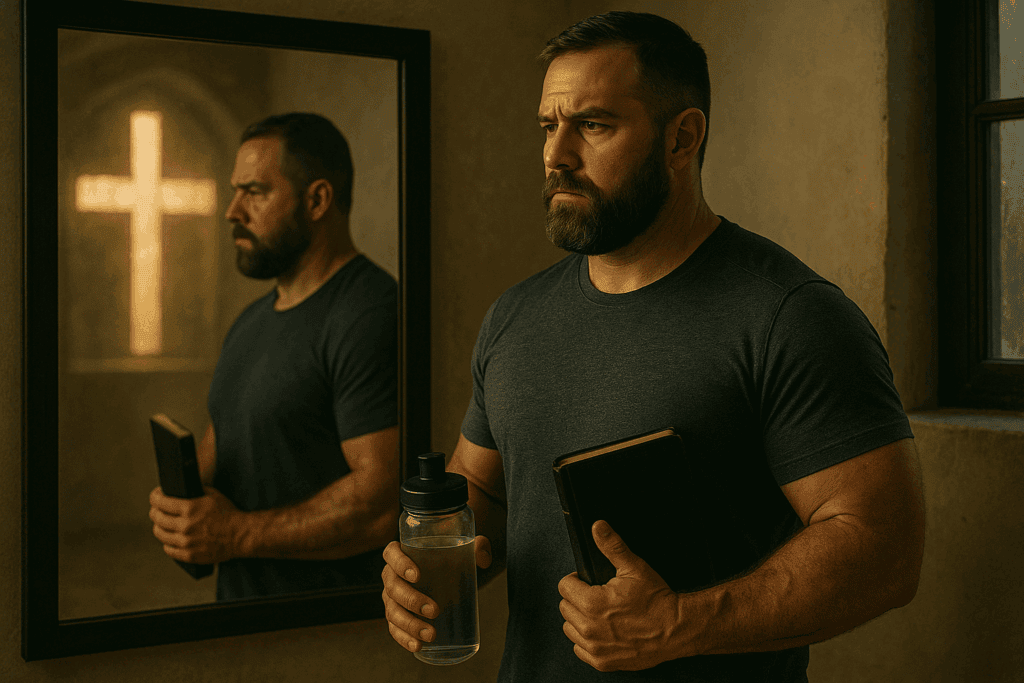
A man stands in his kitchen at 6 a.m., lunch packed, keys in hand, and has no idea what he’s actually supposed to be. Provider? Protector? Sensitive partner? Silent strength? The culture hands him five contradictory scripts before he finishes his coffee. Church often hands him a fuzzier one: “just be a godly man.” True, but not specific enough to build a life on.
Christian masculinity is the God-given calling for men to provide, protect, and lead. These aren’t cultural add-ons — they’re roles built into creation itself, before sin ever entered the picture. Genesis 2:15 places Adam in the garden to work it and guard it. 1 Timothy 5:8 ties provision to faith itself. 1 Corinthians 16:13 commands men to “be strong.” None of this is about dominance or control — it’s strength placed under God’s authority and spent in service of others, modeled fully in Jesus Christ. The rest of this guide unpacks what that looks like in a world that’s genuinely confused about it.
This is not a rehash of the site’s /man-of-god/ post. That piece covers Christian character broadly — integrity, faith, humility, the fruit of the Spirit. This one goes narrower: what does the Bible say specifically about masculinity, the parts of a man’s calling that are distinctly, unapologetically male?
What Masculinity Actually Means in the Bible
Genesis 1:27 says God created mankind in His image, “male and female he created them” (NIV). Both sexes carry the full image of God. Both were given the same opening command in Genesis 1:28 — be fruitful, fill the earth, rule over it. Masculinity isn’t a superior version of that image. It’s a particular expression of it.
Scripture doesn’t stop there, though. Genesis 2 zooms in on the man specifically and assigns him a job before Eve is even introduced. “The LORD God took the man and put him in the Garden of Eden to work it and take care of it” (Genesis 2:15, NIV). Two verbs, two callings, given to Adam alone, before the fall, before marriage, before sin: work it, and guard it. Provider and protector aren’t punishments for sin or cultural baggage from a patriarchal era. They’re built into the blueprint.
That doesn’t make masculinity a performance metric. A man who’s unemployed, or physically unable to fight off a threat, hasn’t failed at being a man. The calling is a posture of the heart — a readiness to provide and protect — more than a checklist. But the posture itself is real, and scripture names it as male from the opening chapters of the Bible.
The Provider: A Calling Older Than the Curse
People often assume “provide for your family” is just practical advice, or an outdated arrangement from a pre-industrial world. Genesis 2:15 says otherwise. Adam was given work to do inside a perfect garden, before anything was broken. Work itself isn’t the curse. Painful, exhausting toil is what the curse adds to it: “Through painful toil you will eat food from it… By the sweat of your brow you will eat your food” (Genesis 3:17-19, NIV). God didn’t invent provision as a punishment. He hardened the ground under it.
The New Testament doesn’t soften this into a suggestion. Paul writes to Timothy: “Anyone who does not provide for their relatives, and especially for their own household, has denied the faith and is worse than an unbeliever” (1 Timothy 5:8, NIV). That’s some of the strongest language in the New Testament for a practical duty. It’s stronger than the language used for plenty of things churches make a much bigger deal of on Sunday morning.
Provision was never only about a paycheck. It’s food, shelter, safety, and stability for the people under your roof — married or not yet, kids or none yet. A single man providing for himself with integrity, refusing to coast on others, is living this out too. That application scales — the calling doesn’t disappear just because the details of a man’s life look different from Adam’s garden or Paul’s Ephesus.
The Protector: The Other Half of Genesis 2:15
The second verb in Genesis 2:15 gets skipped more often than the first. “Take care of” translates the Hebrew shamar — a word that means far more than tidying up. It’s the same word used for the Levites “guarding” the sanctuary (Numbers 3:7-8). It’s also the word for the cherubim God stationed to “guard the way” back into Eden after the fall (Genesis 3:24). Shamar means active, watchful protection against a real threat, not passive maintenance.
That’s a strange word to use for gardening, unless the garden actually needed guarding. Genesis 3 answers that question a few verses later: a threat did get in. Adam was standing right there when it happened (Genesis 3:6) and said nothing. Whatever else went wrong in the fall, the first man failed the protector role before he failed anywhere else.
Scripture doesn’t leave protection as an abstract idea. Centuries later, Nehemiah’s men rebuilt Jerusalem’s walls under threat of attack — “those who carried materials did their work with one hand and held a weapon in the other” (Nehemiah 4:17, NIV). Provider and protector, working at the same time, in the same hands. In Ruth, Boaz steps in as goel — kinsman-redeemer — for two women with no male protector left in their family line. He covers them financially and shields them socially, in a system that offered widows no other safety net. Provision and protection weren’t separate jobs for Boaz. They were one act of covenant loyalty.
What Protection Looks Like Today
Protection today rarely means standing between your family and an armed enemy. More often it’s the boring, daily kind: locking the door at night, screening what your kids watch. It’s having the hard conversation about an influence in your daughter’s life. It’s refusing to let conflict at home go unaddressed just because confrontation is uncomfortable. Passive men skip this and call it “keeping the peace.” Scripture calls it what Adam did in the garden.
The Leader: Authority That Serves
1 Timothy 3 lists the qualifications for a church elder, and the test it gives is almost domestic: “An overseer must manage his own household well… If anyone does not know how to manage his own family, how can he take care of God’s church?” (1 Timothy 3:4-5, NIV). Leadership in the church is proven first at the kitchen table. That should reframe how a lot of men think about leadership. It’s not a stage or a title — it’s a daily, unglamorous responsibility for the people already under their roof.
Ephesians 5 is one of the most contested passages in the New Testament. Christians who love scripture equally land in different places on exactly how headship and mutual submission fit together — a real, ongoing debate worth studying on its own. What both sides agree on is the model Paul gives for how a husband leads: “Husbands, love your wives, just as Christ loved the church and gave himself up for her” (Ephesians 5:25, NIV). Whatever authority a Christian man carries, self-sacrifice is the pattern for using it, not self-interest. Christ’s own model of leadership — washing feet instead of demanding them washed — is the template (the /biblical-servant-leadership/ post walks through this in full).
Self-Control Comes First
None of this works without self-control. Paul tells Titus to “encourage the young men to be self-controlled” (Titus 2:6, NIV) — before anything about strength or authority. A man who can’t govern his own temper, appetite, or eyes has nothing legitimate to offer anyone else’s household or church. Leadership starts as self-leadership.
Joseph shows what that looks like under real pressure, not theory. Sold into slavery by his own brothers, he rose to run Potiphar’s entire household — real provider and leader responsibility, at a young age, in a foreign country. Then Potiphar’s wife propositioned him repeatedly, and Joseph didn’t negotiate with it. He ran, leaving his cloak behind (Genesis 39:6-12). That single decision cost him years in prison. It also kept his integrity intact for the leadership role God had waiting for him in Pharaoh’s court. Self-control isn’t the boring prerequisite to leadership. It’s the proof a man can be trusted with it.
Where Our Culture Got Confused About Masculinity
From the Farm to the Factory to Nowhere
For most of human history, a man’s provider role happened in plain sight. Farm work, trade work, running a shop — it happened at home or close to it, visible to his wife and kids. The Industrial Revolution moved that work into factories miles from the house. For the first time in history, “provider” started to mean “the man who’s gone all day.” The mid-20th-century suburban breadwinner model — one income, one house, one car — was actually the historical exception, not the norm, and it lasted barely a generation.
Brookings Institution scholar Richard Reeves documents what happened after that model broke down in his 2022 book Of Boys and Men. As the economy shifted from valuing physical strength to valuing cognitive and social skills, men without a college degree lost the clearest path to the provider identity they’d been handed. Reeves ties that loss directly to falling wages, dropping life expectancy, and rising family breakdown among that group. Black men, he found, were hit hardest of all, through disproportionate incarceration rates. When a role scripture treats as central to masculinity gets pulled out from under a man economically, confusion about masculinity itself isn’t surprising. It’s the predictable result.
The Fatherlessness Fallout
That confusion compounds when the protector and leader roles go missing too. The National Fatherhood Initiative reports that roughly 1 in 4 children in the U.S. — 18.2 million — currently live without a biological, step, or adoptive father in the home. A boy who never watched a man provide, protect, and lead up close has no living model for any of it. He’s left reconstructing “masculinity” from movies, influencers, and guesswork. That’s exactly how the culture ends up with two broken counterfeits instead of one biblical original.
Two Broken Counterfeits: Passivity and Machismo
Confusion about masculinity tends to resolve into one of two errors, and both miss what Genesis 2:15 actually describes.
The Passivity Counterfeit
Passivity drops the protector and leader roles entirely and calls it humility or peacekeeping. It looks like checking out of decisions at home, avoiding hard conversations, letting a wife or a church carry weight a man was supposed to help carry. It feels safe. Scripture calls it what it is — Adam, standing silently next to Eve while the serpent worked (Genesis 3:6).
The Machismo Counterfeit
Machismo goes the other direction: dominance without service, strength that exists to be admired rather than spent on someone else. The American Psychological Association’s 2018 Guidelines for Psychological Practice with Boys and Men named this pattern directly. It describes “traditional masculinity ideology” — anti-femininity, restricted emotion, and risk, violence, and dominance for their own sake — as harmful when taken to the extreme the guidelines were addressing.
A Real, Named Disagreement
That report drew real, public pushback. Twelve scholars writing in Quillette (2019) argued the guidelines blurred the line between genuinely harmful extremes and ordinary masculine traits like stoicism or competitiveness. That risks real clinical harm, they wrote, by teaching men their normal instincts are pathological. Psychologist Pamela Paresky raised a similar concern in Psychology Today, asking why the same competitive or risk-taking behavior wouldn’t get labeled “masculine” when a woman does it. The disagreement is real, worth naming honestly rather than picking a side and pretending it’s settled. But both camps agree on the actual danger: strength that exists only to dominate, unmoored from any responsibility to serve. That’s the same failure scripture names in Genesis 2:15’s forgotten half — guarding was always supposed to protect someone else, not feed the guardian’s ego.
Pew Research’s 2024 survey on American views of masculinity found the country split almost exactly along this fault line. About 40% think society places too much emphasis on physical strength, assertiveness, and risk-taking in men. A comparable share worries the opposite — that qualities like emotional openness and gentleness in men go undervalued. Both instincts are picking up on something real. Scripture doesn’t ask a man to choose between strength and tenderness. It asks him to aim both at someone other than himself.
| Passivity | Machismo | Biblical Masculinity | |
|---|---|---|---|
| View of strength | Avoided, seen as risky | Worshipped, performed for others | Present, but spent in service |
| Response to conflict | Withdraws, avoids | Escalates, dominates | Engages directly, resolves |
| Motivation | Comfort, self-protection | Ego, status, control | Love for others, obedience to God |
| Model | Adam’s silence (Genesis 3:6) | Worldly rulers “lording it over” (Mark 10:42) | Christ washing feet (John 13:1-17) |
Strength Under Submission: The Biblical Corrective
The corrective isn’t a midpoint between passivity and machismo, some watered-down average of two errors. It’s a third thing entirely: real strength, fully submitted to God, spent on other people. 1 Corinthians 16:13’s four commands run in exactly that order — “Be on your guard; stand firm in the faith; be courageous; be strong” (NIV). Courage and strength show up last, anchored to standing firm in the faith first. Strength without that anchor is just machismo with better PR.
Jesus is the only man who ever lived this out perfectly, and He did it by kneeling with a towel and a basin, not by seizing a throne (John 13:1-17). He had every legitimate claim to raw dominance and used none of it that way. That’s the standard: a total redefinition of what strength is actually for.
If You’ve Already Failed at This
Some of this lands hard, and it should — but not as shame. If you read the provider, protector, and leader sections above and mostly saw where you’ve fallen short, you’re not disqualified. You’re exactly who this is for.
Adam’s failure in the garden wasn’t the end of the story God was telling. David failed as a protector and leader inside his own family in ways scripture doesn’t hide (2 Samuel 11-18). He’s still called “a man after God’s own heart” (1 Samuel 13:14) — not because his failures didn’t matter, but because he kept turning back toward God instead of hardening against Him. That’s the actual bar: not a flawless record, but a direction. A man moving toward this calling, imperfectly, is living it out. A man who’s given up on it entirely isn’t.
This is the same gap the rest of this site talks about constantly — the space between what a man believes and how he actually lives. It shows up here just as much as it does with food, fitness, or money. Closing it isn’t about trying harder in your own strength. It’s about obedience, one decision at a time, with people around you who’ll actually notice if you drift.
A Word for the Women Reading This
If you’re a wife, mother, or sister reading this hoping the man in your life gets it, you’re not wrong to want that. A provider, a protector, a leader who leads by serving rather than demanding — that desire isn’t shallow or old-fashioned. It’s the same shape scripture describes. Pray specifically for him. Name what you actually see — both the strength and the passivity, both the leadership and the places he’s checked out. Resist the urge to fill the gaps yourself out of frustration. A man rises toward what’s expected of him far more often than he rises toward what’s done for him.
Common Objections, Answered Honestly
“Isn’t This Just Outdated 1950s Gender Roles?”
No. The roles trace back to Genesis 2, roughly 3,400 years before the 1950s breadwinner model existed, and that breadwinner era was actually a narrow historical blip, not the biblical norm. Provider and protector show up in an ancient agrarian economy, a Persian-era city under siege (Nehemiah), and a New Testament house church. The application changes with the century. The calling doesn’t.
“What If I’m Not a Natural Leader or Provider?”
Neither was Moses, who argued with God about his own inadequacy for four chapters (Exodus 3-4) before leading a nation out of Egypt. The calling was never about natural talent. It’s about showing up, obedient and willing, and trusting God with the rest.
“Doesn’t the Bible Also Call Women to Work and Provide?”
Yes. Proverbs 31’s wife trades in the marketplace, plants a vineyard, and provides for her household (Proverbs 31:16-18). Masculinity isn’t a monopoly on competence or contribution. It’s a specific calling laid on men, not a claim that women are incapable of the same things.
“Isn’t ‘Protector’ Just an Excuse for Aggression or Control?”
Only if it’s detached from the model. Biblical protection guards others, especially the vulnerable — it doesn’t dominate them. Boaz protected Ruth by giving up his own interests, not by asserting power over her. That’s the test: does this “protecting” cost the man something, or does it just give him control?
“I’m Not Married and Don’t Have Kids Yet — Does This Apply to Me?”
Yes. Adam received the provider and protector calling in Genesis 2, before Eve was created and before there was a family to lead. A single man lives this out by providing for himself with integrity instead of coasting on parents or the system. He guards his own character and the people already in his life — friends, parents, a future spouse he hasn’t met yet. He builds the self-control now that leadership will require later. The calling doesn’t start at the wedding. It starts today.
What This Looks Like This Week
At home: Have the budget conversation you’ve been avoiding. Notice one thing your kids or wife need protecting from — a screen, an influence, an unaddressed conflict — and address it directly instead of hoping it resolves itself.
At work: Provide with integrity, not just a paycheck. Show up on time, do the job you’re actually paid to do, and treat provision as worship rather than a grind to survive.
At church and in your community: Lead somewhere, even in a small way — a men’s group, a service project, a younger guy who needs someone further down the road to talk to. Leadership starts small, at your own kitchen table, long before it looks like anything public.
Where to Start
Project Kingdom Gladiator was built to cover exactly this ground: not vague encouragement to “be a better man,” but a concrete framework for becoming the provider, protector, and leader scripture describes, body and soul together. Over a decade-plus of training men and running fitness programs, the pattern shows up constantly. The men who get physically stronger without ever addressing what that strength is for usually don’t keep it. The ones who tie it to a calling — providing, protecting, leading — do.
Start with the free Kingdom Reset 5-Day Fast, inside the Kingdom Gladiators Skool community — a place to close the gap between what you believe about masculinity and how you’re actually living it out this week.