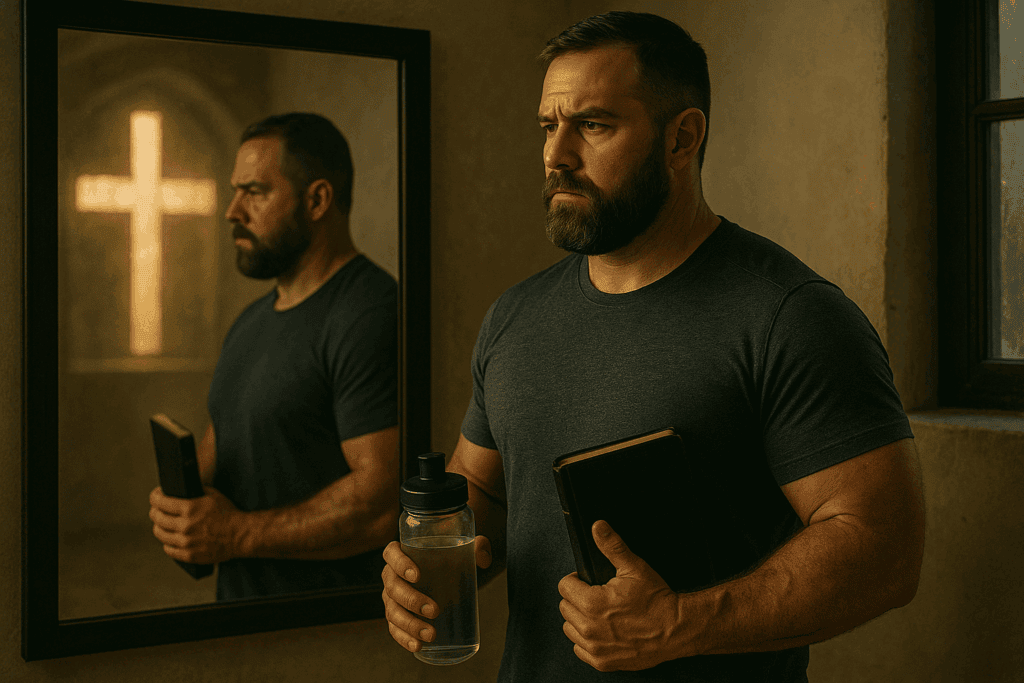
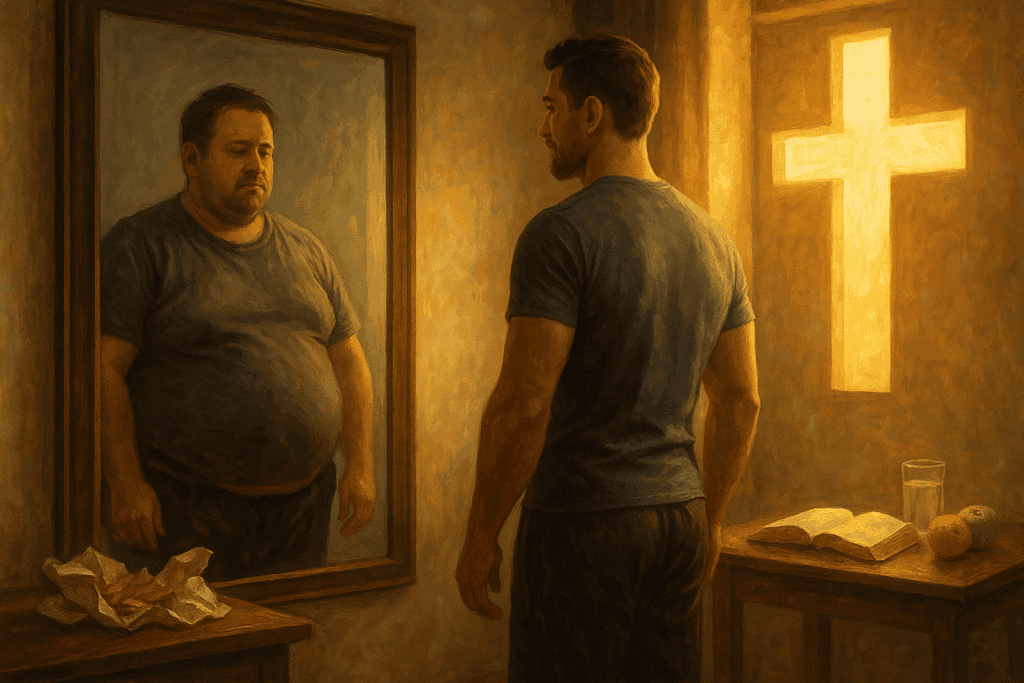
You sit in the third pew Sunday morning, sing the songs, mean the words, and still feel nothing underneath them but gray. Monday you go to work, coach practice, lead family devotions, and nobody in your house has any idea how heavy the mornings have gotten. Christian depression rarely announces itself. It just sits underneath a life that still looks like it’s working.
Christian depression is not a sign of weak faith, hidden sin, or spiritual failure. Scripture treats it honestly — Elijah asked God to take his life, David wrote entire psalms about it, and it never once earns either man a rebuke. Modern research confirms depression involves real, measurable changes in brain chemistry, which is why professional treatment works alongside faith instead of against it. Getting help is not giving up on God. For a lot of men, it’s the most obedient thing they’ll do all year.
You’re Not the First Man of God to Ask God to Take Your Life
Elijah had just won. He called down fire from heaven in front of all Israel and exposed 450 prophets of Baal as frauds. The whole nation shouted that the Lord is God (1 Kings 18:36-39). Then Queen Jezebel threatened to kill him, and the prophet who’d stared down false gods without blinking ran for his life into the wilderness.
He sat down under a juniper tree and prayed to die. “I have had enough, LORD,” he said. “Take my life; I am no better than my ancestors” (1 Kings 19:4, NIV). This is one of the highest-profile prophets in the Old Testament, fresh off the biggest miracle of his career, asking God to let him stop existing.
God’s response wasn’t a lecture. An angel woke him up, twice, and told him to eat. He let him sleep. Only after Elijah had food, water, and rest in his body did God speak. Not in the wind, the earthquake, or the fire — in “a gentle whisper” (1 Kings 19:11-12). Before God addressed Elijah’s soul, He addressed his body. That order matters for anyone assuming depression is purely a spiritual problem to pray away.
The Bible Doesn’t Skip the Dark Parts
Scripture doesn’t sanitize despair. Of the 150 psalms, scholars count 58 as psalms of lament — 42 individual, 16 communal. Writers pouring out grief, confusion, and anger straight at God (GotQuestions.org). That’s nearly 40 percent of the whole songbook of Israel’s worship.
David asks his own soul, “Why, my soul, are you downcast? Why so disturbed within me?” (Psalm 42:11, NIV) — and doesn’t pretend to have the answer in the same verse. Psalm 88 goes further than any other psalm and never resolves. It ends: “You have taken from me friend and neighbor — darkness is my closest friend” (Psalm 88:18, NIV). No turn to praise. No tidy ending. It’s in the Bible anyway.
Job cursed the day he was born (Job 3:1-3). Jonah told God he’d rather die than keep living (Jonah 4:3). Jeremiah, a man who spent his whole ministry faithfully obeying God, wished he’d never been born (Jeremiah 20:14-18). None of these men get corrected for how they felt. Job’s friends get rebuked later for their bad theology about his suffering (Job 42:7) — Job’s honesty was never the problem.
Even Jesus Was “Overwhelmed with Sorrow to the Point of Death”
In Gethsemane, the night before the cross, Jesus told His closest friends: “My soul is overwhelmed with sorrow to the point of death” (Matthew 26:38, NIV). That’s not a metaphor for mild stress. Hebrews says Jesus was tempted in every way, “yet did not sin” (Hebrews 4:15) — which means whatever He felt that night wasn’t sin, either.
If sorrow that heavy could sit in Jesus without it being a spiritual failure, it isn’t automatically one in you.
What Depression Actually Is, Not a Character Flaw
Depression has a clinical definition and real numbers behind it — it isn’t a vague personal failing. An estimated 21 million U.S. adults, 8.3 percent of the population, experienced at least one major depressive episode in the past year. That’s the National Institute of Mental Health’s most recent national survey figure. Women are affected at higher measured rates than men — 10.3 percent versus 6.2 percent. That gap partly reflects how much less often men get diagnosed at all, not necessarily how much less they suffer (NIMH).
Roughly 61 percent of adults with major depression get some kind of treatment. Among the most severe cases, that number rises to nearly 75 percent (NIMH). Most people who get help, get better. The bottleneck usually isn’t whether treatment works. It’s whether a man believes he’s allowed to ask for it.
Christian Depression vs. Ordinary Sadness — What’s the Difference?
Losing a job, a marriage, or a parent should make a man sad. That sadness usually rises and falls with the loss itself — hard on the anniversary, easier on an ordinary Tuesday, connected to a cause you can name. That’s grief, and grief isn’t a disorder to fix. It’s what love costs when something you loved is gone.
Clinical depression behaves differently. NIMH describes it as a persistent low mood or loss of interest lasting most of the day, nearly every day, for two weeks or longer. Often there’s no single event that explains it, and it doesn’t lift even when circumstances improve. A man can get the promotion, watch his kid win the game, sit in a good marriage, and still feel nothing underneath any of it. That flatness across everything, not just around one wound, is the signal worth taking to a doctor instead of waiting out.
Neither one makes a man less faithful. But they call for different responses — grief usually needs time, presence, and people who’ll sit with it. Depression usually needs an actual evaluation, because the brain chemistry driving it doesn’t resolve on its own timeline the way grief tends to.
Why Christian Men Specifically Go Quiet
Even the men leading churches struggle to talk about this. In a LifeWay Research survey, 23 percent of pastors said they’d personally experienced some form of mental illness, and 12 percent had a formal diagnosis. Yet 66 percent of senior pastors said they rarely or only occasionally address mental illness from the pulpit (LifeWay Research). If the men trained to shepherd a congregation mostly stay silent about it, the men in the pews learn the same silence.
That silence costs more for men than for women. In 2024, suicide deaths among men outnumbered women’s roughly four to one — 38,977 versus 9,847 — even though women report depression at higher rates (AFSP). Men are diagnosed less and die from it more. That gap is what happens when “strong and silent” becomes the only acceptable posture for a Christian man.
Two Preachers Who Fought Depression and Kept Preaching
Charles Spurgeon, the “Prince of Preachers,” preached to thousands weekly and still wrote openly about his own depression. “Knowing by most painful experience what deep depression of spirit means,” he told a room of fellow pastors. He described it as a recurring visitor, not a one-time event (HavenToday). He named ministry’s emotional weight, physical exhaustion, and even the letdown after major victories as causes — the same pattern Elijah lived out after Mount Carmel. His counsel wasn’t to fake his way out of it. It was to keep resting, keep trusting, and keep serving anyway.
William Cowper attempted suicide three times before he was 32 and spent time in an asylum. While there, reading Romans 3:25 broke something open in him, and he described being flooded with belief he hadn’t been able to access before (Desiring God). He went on to write dozens of hymns with pastor John Newton, the man behind “Amazing Grace.” One of them is “God Moves in a Mysterious Way.” It’s still sung in churches today. Depression kept returning for the rest of his life. It never disqualified him from being used by God. Both men wrote some of their most enduring work in the middle of the struggle, not after it was resolved.
Is Taking Medication or Seeing a Therapist a Lack of Faith?
No — and the church’s own history backs that up. Trauma surgeon and writer Kathryn Butler, MD, makes the case that clinical depression involves measurable changes in brain chemistry and structure. Willpower or faith alone can’t reverse that on their own. She calls medical treatment “God’s gifts of common kindness,” on the same level as any other medicine a Christian would take without a second thought (Desiring God). Medication and counseling are described as necessary but not sufficient on their own — meant to work alongside prayer and community, not instead of them.
There’s a real, honest disagreement inside the church about this. Some in the biblical counseling tradition worry that leaning too hard on secular therapy or medication can crowd out the deeper work of walking with God. That concern is worth taking seriously — treatment should never become a replacement for a relationship with Christ. But refusing all outside help isn’t the historic Christian norm, either. Cowper had a doctor. Elijah had food, water, and sleep before he had a word from God. Care for the body and mind has always sat alongside care for the soul, not against it.
Therapy works the same way. A licensed counselor isn’t competing with your pastor or your prayer life. A good one will usually tell you outright that they aren’t equipped to be either of those things. What they offer is a trained, outside set of eyes on patterns you’re too close to see in yourself. That’s a different tool for a different job, not a rival belief system.
Faith and Treatment Aren’t Competing
Faith and treatment appear to work together, not in competition. A Harvard study of nearly 110,000 adults looked at “deaths of despair” — suicide, overdose, alcohol-related death. Men who attended religious services weekly had a 33 percent lower risk, compared to those who never attended. Women had a 68 percent lower risk (Harvard T.H. Chan School of Public Health). Community and faith reduce risk. So does treatment. There’s no reason to choose only one.
Is It a Sin to Be Depressed?
No. Suffering and sin are not the same thing, and Scripture is careful about that distinction. Elijah wasn’t punished for despair. Job wasn’t punished for lament. Depression is usually some mix of brain chemistry, sleep, grief, unresolved circumstances, or plain physical illness — not a scoreboard showing how much God approves of you.
That doesn’t mean nothing in a man’s life ever needs to change. Unconfessed sin, isolation, and years of neglecting sleep and health can absolutely make depression worse. But the presence of depression itself isn’t evidence God is angry, or that a man’s faith is too small. Elijah’s faith had just moved a mountain of prophets. He still ended up under that tree.
Why Hasn’t God Healed Me If I Have Enough Faith?
Paul asked God three separate times to remove a “thorn in my flesh.” God said no. His answer was: “My grace is sufficient for you, for my power is made perfect in weakness” (2 Corinthians 12:7-9, NIV). The healing Paul asked for never came. Paul kept preaching anyway, and most of the New Testament exists because he did.
That same Paul wrote elsewhere about a season so dark he “despaired even of life.” He felt like he’d received “the sentence of death” in himself (2 Corinthians 1:8-9, NIV). The man who wrote nearly half the New Testament wasn’t exempt from wondering if he’d survive his own mind. Faith didn’t prevent it, and its presence afterward didn’t mean God had been distant the whole time.
Spurgeon and Cowper prove the same point from church history. Neither man’s depression ever fully lifted this side of eternity. Both kept serving anyway. It wasn’t because they finally had enough faith to make the depression go away. It was because faith and unresolved suffering turned out to be able to sit in the same life at the same time. If a cycle of depression hasn’t broken yet, that isn’t proof you’re doing faith wrong. Paul didn’t get to write that verdict about his own thorn, and neither do you.
Daily Habits That Support Real Treatment — Not Replace It
None of what follows is a cure. If what you’re feeling has lasted more than two weeks, that calls for a doctor or a licensed counselor. If it includes any thought of ending your life, that calls for the crisis line below — not a new morning routine. These habits are support, meant to run alongside real treatment, not around it.
Sunlight
Light exposure changes brain chemistry in a measurable way. Mayo Clinic notes that light therapy “mimics natural outdoor light and appears to cause a change in brain chemicals linked to mood.” It’s typically effective within days to a few weeks. Side effects are rare. The guidance is simple: get bright light exposure within the first hour of waking (Mayo Clinic). You don’t need a light box for a daily habit — ten to fifteen minutes outside without sunglasses, first thing, does the same basic job.
Movement
A meta-analysis of 49 prospective studies covering multiple continents looked at physical activity and depression risk. People with higher activity levels had 17 percent lower odds of developing depression than inactive people. The effect held consistently across age groups (American Journal of Psychiatry, Schuch et al., 2018). It doesn’t take a punishing workout. A daily walk counts. The body was built to move — the very first assignment God gave Adam was physical work in the garden (Genesis 2:15). A body that never moves tends to carry mood problems it doesn’t need to.
Community
Isolation is dangerous in a way that’s easy to underestimate. The U.S. Surgeon General’s 2023 advisory found that lacking social connection raises the risk of premature death by 26 to 29 percent. That’s comparable to smoking up to 15 cigarettes a day. People who report frequent loneliness are more than twice as likely to develop depression. Social isolation was named the single strongest predictor of suicidal thoughts and behavior. A man living alone faces more than double the suicide risk of one who isn’t (U.S. Surgeon General). That’s not a soft, sentimental argument for friendship. It’s a physical safety issue. A men’s group, a small group, a standing weekly call with someone who’ll actually ask how you’re doing — none of it is optional if you’re struggling.
Scripture and Prayer
This isn’t a magic fix. Treating it like one sets a man up to feel like a bigger failure when a Bible reading plan doesn’t lift a clinical depression. What it does offer is language for what’s happening. “Pour out your hearts to him” (Psalm 62:8, NIV) is permission, not a suggestion to perform gratitude you don’t feel. On the hardest days, reading a lament psalm out loud — Psalm 13, Psalm 42, Psalm 88 — can say what you can’t yet find words for. It’s a reminder that being honest with God has never been the thing that pushes Him away.
When to Get Help Right Now
Some of what depression feels like calls for immediate action, not a new habit next Monday.
| If you’re experiencing… | Do this |
|---|---|
| Hopelessness or low mood most days for two weeks or more | Talk to a doctor or licensed counselor this week |
| Loss of interest in everything you used to care about | Same — this is a clinical symptom, not laziness |
| Any thought of self-harm or suicide | Call or text 988 (Suicide & Crisis Lifeline) right now, or go to the nearest ER |
| Withdrawing from everyone around you | Tell one person today — a spouse, pastor, or friend — even if it’s just “I’m not okay” |
| Sleep falling apart — barely sleeping, or sleeping most of the day | Talk to a doctor. Sleep and depression feed each other in both directions |
| Can’t function at work or home | That’s a medical situation, not a discipline problem. See a doctor |
If you are thinking about ending your life, call or text 988 right now. That is not a faith test you’re failing by picking up the phone.
How to Tell Someone You’re Struggling
Most men rehearse this conversation for months and never have it. The good news: the people in your life probably want you to. In that same LifeWay Research survey, 65 percent of family members of someone with mental illness wished their church talked about it more openly. So did 59 percent of people with a mental illness themselves (LifeWay Research). The silence most men are afraid to break is usually a silence the people around them are waiting for someone to break first.
It doesn’t need to be a speech. “I’m not doing okay, and I think I need to talk to someone” is a complete sentence. Say it to your spouse first if you’re married — she’s already noticed something’s off, and guessing what it is alone is harder on her than knowing. Say it to a pastor, an elder, or one friend you trust not to treat it as gossip. You don’t owe anyone a full explanation to be allowed to ask for help.
You Weren’t Meant to Carry This Alone
After the whisper on the mountain, God didn’t leave Elijah to recover by himself. He gave him a job to do and a companion for it — Elisha, who walked beside him for the rest of his ministry (1 Kings 19:19-21). Community wasn’t an afterthought to God’s response to a suicidal prophet. It was built into the plan from the start.
If you’re in a depressive episode right now, talk to a doctor before starting any fast — this isn’t the week to test your body’s limits. When you’re ready, the free Kingdom Reset 5-Day Fast inside the Kingdom Gladiators community on Skool exists for exactly this. Men walking the same road, together, instead of white-knuckling it alone.
I’m a certified personal trainer with over a decade in the fitness industry. I built the Holy Diet and Temple Training system from direct study of scripture. I’m not a licensed counselor or physician, and nothing here replaces one. This post exists to say plainly that seeking that kind of help was never a lack of faith. More at the About page.