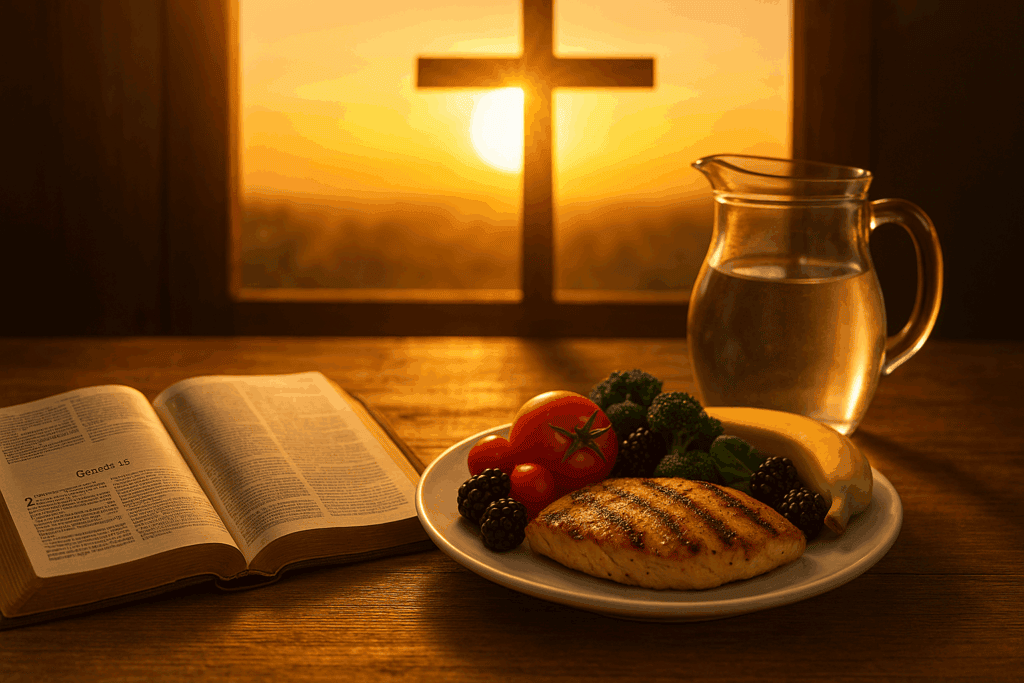
Somebody in my Skool community asked me last week what I actually eat in a day. I’d never answered that straight. So here it is: a biblical diet full day of eating, meal by meal.
This is exactly how I ate it this week.
A biblical diet full day of eating for weight loss starts with black coffee or protein coffee. Lunch is lean meat and seed-bearing plants. Dinner is clean meat and vegetables, usually around 5:30 or 6:00pm. From there, you hit a protein target instead of counting every gram, and stop eating a few hours before bed. That’s it: no shakes replacing meals, no supplements doing the heavy lifting.
Here’s exactly how that played out for me today, and why I built it this way.
Why I Stopped Looking for a Better Diet and Started Reading the One Book I’d Skipped
I was a personal trainer for over a decade before I ever fixed my own body. I put clients on keto, on carnivore, on macro counting down to the gram. The whole time, I carried 30 to 40 pounds I wanted off myself.
The idea for what became Project Kingdom Gladiator hit me in church. I was half listening to a sermon, making a mental list of every diet my clients had cycled through.
I remember thinking: if I want the perfect diet, I should probably go ask the guy who’s actually perfect. So I opened my Bible looking for an answer instead of another app.
Genesis 1:29 is the first place scripture talks about food at all, and it’s not vague. God tells Adam to eat seed-bearing plants and fruit. Leviticus 11 later adds which meats are clean.
I didn’t invent a diet. I found one that had been sitting in the book the whole time. And I felt a little dumb for spending years looking everywhere else first.
That’s the Holy Diet, the long-term eating pattern underneath everything I do now.
One honest note before the food: Genesis 1:29 describes Eden, before the flood. It’s plants only, no meat mentioned. Meat isn’t explicitly permitted until Genesis 9:3, after Noah.
That’s when God tells him “everything that lives and moves will be food for you.” I eat both because I believe both are still good instruction. Genesis 1:29 alone doesn’t get you to a rotisserie chicken.
My Morning: Walking With God, Then Protein Coffee
I don’t eat the second I wake up. First comes what I call Walking With God cardio. It’s 20 to 40 minutes of low-intensity walking that I treat as devotional time, not a workout.
Right now I follow that with whatever training block I’m in, currently the Arc Blueprint, my Noah’s-ark-inspired strength program.
Then coffee. If I’m doing a fasting day, it’s just black coffee. On a normal eating day, I add one or two scoops of whey protein to the coffee.
I call it protein coffee. It’s my whole breakfast, usually somewhere around 7 or 8am.
I know that sounds too simple to work, and it’s supposed to be. Whey protein this early does two things worth knowing. It starts feeding muscle protein synthesis before I’ve eaten a real meal.
It also helps blunt hunger for the next few hours. That happens by lowering ghrelin, the hormone that makes you feel hungry (research summarized on Biolayne). I’m not chasing a trend, just front-loading the one macro that actually keeps me full.
I’ll be honest about the Walking With God cardio too. Some of you will ask if doing it fasted is the secret sauce. Research shows fasted low-intensity movement increases fat oxidation during the walk itself, roughly 20 to 25 percent higher than the same walk after breakfast (per a 2023 review cited by BodySpec).
But studies comparing fasted and fed walking over weeks and months don’t show a clear difference in actual fat lost. I still do it fasted. It’s devotional time before my day gets loud, not some metabolic hack burning extra pounds nobody else’s walk would.
Lunch: A Costco Caesar Salad or a Burrito Bowl, Nothing Fancier
Lunch lands around 11am to noon, and it’s one of two things on repeat. Most days it’s half a bag of the Costco Caesar salad kit. I cut about 200 grams of rotisserie chicken into it.
Other days it’s a burrito bowl instead. That’s a can or two of black beans, the same 200 grams of chicken, and one guacamole packet.
Every Sunday I buy a rotisserie chicken and break it down myself. I portion out what I’ll use through the week. It takes maybe 15 minutes, and it’s the single thing that makes weekday lunch require zero decisions.
I’m not cooking a new lunch every day, just assembling the same reliable one from parts I already prepped.
I didn’t land on Sunday by accident either. It’s the one day my schedule has a real gap. That turns meal prep into something closer to a Sabbath rhythm than a chore.
One hour of work buys me five easy lunches. It doesn’t have to be Sunday for you. It just has to be some fixed hour you protect every week.
Otherwise, “I’ll figure out lunch later” quietly turns into a drive-through decision. A hungry, tired version of you makes that call at 11:45am.
This is Leviticus 11 clean meat, paired with black beans. Black beans count as one of the seed-bearing plants from Genesis 1:29. It’s not complicated.
God named these same two food categories on day one and later in Leviticus. I just assemble them fast enough that I actually eat lunch instead of skipping to a protein bar.
Dinner Is My Wife’s Job, and I’m Not Sorry About That
Here’s something I don’t think gets said enough in fitness content: I don’t cook dinner. My wife does, and she’s good at it.
Most nights it’s some clean meat, weighed out so I hit my protein number. Next to it: roasted vegetables, or a soup built around seed-bearing plants.
That weighing part matters more than people expect. I’m currently in a fat-loss phase, targeting 2,100 calories and roughly 200 grams of protein a day. The only way I hit that number consistently is by knowing what’s on the plate instead of guessing.
High-protein diets have a well-documented effect on appetite and fat loss. One clinical review found something striking: a high-protein diet cut spontaneous daily calorie intake by over 400 calories. It produced meaningful weight loss through increased satiety, not just discipline (published in The American Journal of Clinical Nutrition).
There’s a second reason the protein number matters beyond appetite: it’s what keeps the weight I lose actual fat, not muscle. One study on women in a calorie deficit found something specific: higher protein intake preserved lean body mass during weight loss, compared to a lower-protein version of the same deficit (published on PubMed).
That distinction matters more than the number on the scale. Losing 20 pounds of fat and 20 pounds of muscle move the scale the same amount. Only one leaves you stronger than when you started.
Dinner lands early for me, usually 5:30 to 6:00pm. More on why in a minute.
[NEED: photo of a typical weighed-out dinner plate here]
Yes, I Have a Sweet Tooth, Even on the Holy Diet
I’m not going to pretend I don’t want something sweet at night, because I do, every night. My move is a serving or two of dried mango and pineapple.
Sometimes it’s fresh sliced pineapple, when I’ve got one in the kitchen.
Worth knowing: dried fruit is more calorie-dense than fresh, ounce for ounce. Drying concentrates the natural sugar as the water leaves. A cup of fresh apricots runs about 75 calories.
The same cup dried is closer to 313 (per Harvard Health). That’s not a reason to avoid it. It’s a reason to weigh it like everything else on this plan.
Otherwise it’s easy to eat straight from the bag until it’s gone.
My other move, and this one might sound ridiculous: a sugar-free root beer with a vanilla protein shake mixed in. It basically tastes like a root beer float.
That combination usually closes out my calorie and protein targets for the day almost exactly. It’s a dessert that’s also doing work.
Why I Don’t Eat After 7pm
My snack wraps up by 6:37 at the latest, and I don’t eat anything past 7pm. I go to bed around 10, so that gives me a solid three-hour buffer. I didn’t pick that number randomly.
Research on meal timing and sleep is fairly consistent here. Eating close to bedtime delays sleep onset and increases nighttime waking. Researchers also link a longer gap, 4 to 6 hours between your last meal and lights-out, to better sleep outcomes (summarized in a 2025 review in Nutrients and by the Sleep Foundation).
Digestion runs on its own circadian rhythm. It’s measurably less efficient at night. That’s part of why a heavy meal right before bed tends to sit like a rock instead of digesting clean.
It can also trigger the kind of heartburn or reflux that keeps you up.
I noticed this pattern in my own life before I ever looked up why. Eat late, sleep worse, wake up hungrier and more likely to make a bad food decision the next day.
Cutting off food by 7pm wasn’t a rule I read in a book. It’s a pattern I noticed first, and then found the research backing up after the fact.
Where the “One Serving of Bread” Rule Went Today
You’ll notice there’s no bread or pasta anywhere in this day. The Holy Diet allows one serving of either per day, even so. That’s not a rule I’m breaking.
It’s a rule I’m choosing not to use most days. Bread and pasta are where my own self-control gets shaky. If I build a serving into my day-to-day, it tends to turn into more than a serving.
So I save it. That serving I’m “allowed” and don’t spend most days matters. It’s exactly why I can sit down to a real deli sandwich every once in a while, without it wrecking my week.
The rule was never “you must eat bread daily.” It’s “you’re allowed one,” and allowed isn’t the same as required.
What the Bible Actually Says About Clean Meats, and Where I’m Honest About the Debate
God gave Leviticus 11’s clean and unclean animal categories specifically to Israel. There’s real, ongoing debate among Christian scholars about whether those categories still apply to believers today. Many Christians read Mark 7:19 as Jesus declaring all foods clean.
Other scholars point to Acts 15 instead. There, the Jerusalem Council still told new Gentile believers to avoid things like blood and meat from strangled animals, straight out of the Law of Moses. They argue the picture is more complicated than a clean break (BibleHub lays out both readings in detail).
I’m not going to tell you my reading is the only faithful one. Here’s why I personally follow the Leviticus categories anyway, not because I believe I’m bound to Mosaic law for salvation, but because I’ve found real, practical wisdom in it.
Clean, lean meats, no pork or shellfish, line up well with basic fat-loss nutrition too.
Same logic applies to not combining meat and dairy. That practice actually comes from a rabbinic expansion of “do not boil a young goat in its mother’s milk,” a command the Torah repeats three times. It’s not a direct verse banning cheese on a burger (background at Chabad.org).
I follow it as a discipline I’ve chosen. It’s not a law I’m claiming binds you.
Questions I Get About This Day
Is this a fasting day?
No, this is a full eating day, three meals plus a snack, not the Kingdom Reset. The Holy Diet also includes a weekly fast. That’s either one 24-hour fast (dinner Saturday to breakfast Monday) or daily intermittent fasting until noon-ish, but this wasn’t that day.
If you want the theology behind fasting itself, see Biblical Fasting: What the Bible Actually Teaches. If you’ve never fasted before, How to Fast walks through the mechanics.
Is this only for men?
No. Most of the people I talk to about this are men, but the eating pattern itself isn’t gendered. Your protein and calorie targets change based on your goal weight and activity level, not your sex.
I’ve got women in my community eating this same structure at their own numbers.
What if you don’t like coffee or protein powder?
Then skip both. The point of protein coffee is hitting a protein target early without a full meal, not the coffee itself. Eggs, Greek yogurt, or a smaller version of my lunch would do the same job.
Do you ever eat out or miss a day?
Yes. I mentioned the deli sandwich earlier, and that’s real, not a hypothetical. The Sunday chicken prep is what makes the other six days easy, not a cage that breaks if one meal doesn’t match.
Doesn’t this get repetitive?
Some days, yes. But that’s exactly what I was missing on keto, carnivore, and every plan before this one. They had variety and no staying power.
A boring lunch I actually eat beats an exciting one I abandon in three weeks. That’s why I’ve run the same lunch for months without touching it. Dinner is where the variety lives, since my wife’s cooking it.
The day isn’t as monotonous as the lunch section makes it sound.
Is “Biblical Diet” Just Marketing? I’d Rather You Ask Than Assume
I’ll say this too, because I’d rather bring it up myself. Modern “biblical diet” books, going back to Jordan Rubin’s Maker’s Diet in 2004, have taken real criticism from theologians. They argue some of these plans lift biblical language out of context.
The end result is really just a secular diet plan with verses stapled on (Modern Reformation lays out this critique).
Most of that criticism targets plans built around the Ezekiel bread or Daniel Fast. Authors stretch a few narrow, descriptive verses about what one prophet ate into a marketed diet system. That’s a fair hit.
I built the Holy Diet on the two places scripture is actually prescriptive about food for everyone: Genesis 1:29 and Leviticus 11. That’s not a description of what one man ate during a 21-day vision. It doesn’t make me immune from criticism.
It just means I picked the sturdier foundation, on purpose, after reading the same critique you might be thinking of right now.
I’m not claiming an airtight theological system nobody can question. Instead, I’m pointing at real, specific results. Five days of the water-only Kingdom Reset dropped 13 pounds off me.
An earlier version of this pattern, before the full four-phase structure existed, took 22 pounds off in 40 days. I’m not asking you to trust a theory here. I’m showing you my plate.
How to Build Your Own Version of This Day
Honestly, my exact meals aren’t the point. The structure underneath them is. Maybe you want to build your own version of this day instead of copying mine item for item.
Here’s the order of operations I’d walk a beta cohort member through.
Start with your goal weight, not your current weight, to set your protein target: roughly 0.7 to 1 gram per pound of goal bodyweight. That’s where my 200 grams comes from. Then set your calories.
A moderate deficit of 500 to 750 a day under maintenance gets you about a pound to a pound and a half off a week. It won’t wreck your energy or sleep. My 2,100 is what that math looks like for my stats and goal.
From there, fill the day with two categories God already named: seed-bearing plants (vegetables, beans, fruit, nuts) and clean meats per Leviticus 11 (no pork, no shellfish). Build your protein sources first. Then fill in around them with vegetables and fruit until you hit your calorie number.
Weigh your food for the first few weeks, even if it feels tedious. It’s the fastest way to stop guessing and start actually hitting a number you set on purpose.
You don’t need anything expensive to do this. A kitchen scale runs about 15 dollars. Any free calorie-tracking app will log the math once you’ve weighed the food.
The tool isn’t the hard part. The hard part is doing it every day, long enough that it stops feeling like tracking. Eventually it just feels like knowing what’s on your plate.
Where Today Fits in the Bigger Picture
This particular day is just the long-term maintenance pattern, the Holy Diet. It’s not one of the harder entry points, like the 5-day Kingdom Reset fast or the 5-day Adam Fast that follows it.
Those come first in the actual program, days 1 through 10. Only after that do you land on a normal eating day like the one I just walked you through.
The eating side is also only half of Project Kingdom Gladiator. The training side runs alongside it in four phases. There’s the Arc Blueprint I’m on right now, a muscle-building block built off Tim Ferriss’s approach in The 4-Hour Body.
The Samson Strength System is next, a straightforward 5×5 strength program. After that comes the Armor of God Total Body Program, based on Ryan Fischer’s Chalk Performance Training system. And there’s Cross Space Fit, a rotating, choose-your-own-workout format for once you’re maintaining instead of chasing a number.
This day of eating is the fuel underneath whichever of those four I’m running at the time.
I started this specific push at 272 pounds. Today I’m at 255. That’s 17 pounds gone since I started actually living this out instead of just teaching it.
I’m still in the fat-loss phase, still weighing my dinner, still stopping at 7pm.
Why Listen to Me on This
I’ve been a personal trainer since 2011 and worked inside the fitness industry until 2024. The nutrition and training side of this isn’t new to me. What’s newer is the Bible study.
That came out of genuinely wrestling with scripture, not a weekend project to slap a verse on an existing diet plan. This isn’t me writing from the other side of my own transformation, looking back. I’m 17 pounds into it, eating this exact day as I write about it.
That also doesn’t make me the expert standing above you, handing down a plan. I’m the guy still doing the work, still weighing chicken on a Sunday afternoon, still fighting the same 6:45pm urge to eat something I said I wouldn’t.
The five people in my current beta cohort are eating a version of this same day right now. They’re at the same table I’m at, not a table I used to sit at years ago.
If you want the full breakdown, Kingdom Reset through the long-term Holy Diet, [LINK: Holy Diet pillar post] has the complete structure. You can also read more about where this whole thing started on my About page.
Or reach out directly through my Contact page if you’ve got questions this post didn’t answer.
Start With the Free Entry Point
You don’t need to figure out your own version of this day from scratch. The Kingdom Reset, the same 5-day fast that took 13 pounds off me, is the free entry point into the Kingdom Gladiator community.
It’s where every person in our current beta cohort started too.
Stop looking for the next diet to try. Go read what the first one actually said.