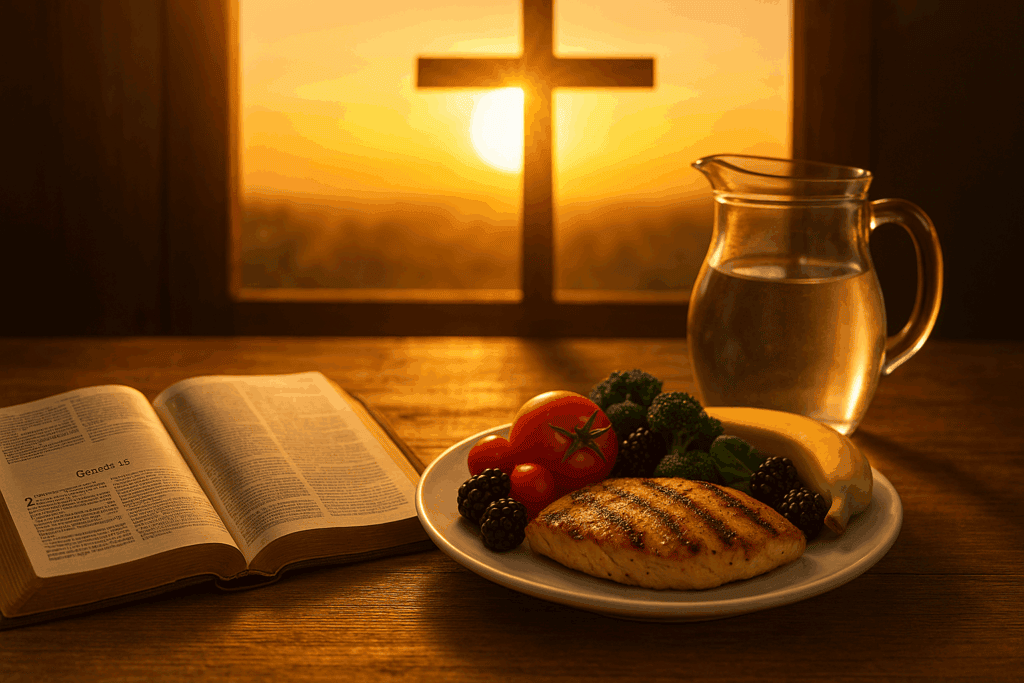
Nobody in the Bible ate breakfast.
Not in the way you think of breakfast. The ancient Israelite day started with work, prayer, and labor — not a meal. The first meal of the day came late morning at the earliest, often midday. A second meal came in the early evening. That was it.
The three-meal-a-day structure — breakfast, lunch, dinner — is not from scripture. It’s not from nature. It developed in Western culture over the last few centuries and accelerated after industrialization made food cheap and constant access normal.
The human body was not designed for it.
Christian intermittent fasting is not a trend that somebody decided to baptize with a Bible verse. The daily fasting window is the eating pattern that runs through scripture from Genesis to Revelation, built into the biology of the body God designed, and available to every Christian man who wants to use the tool God already gave him.
How Ancient Israelites Actually Ate
Modern assumptions about meal frequency don’t hold up when you examine biblical culture.
The ancient world operated on a two-meal pattern. Workers went into the fields or to their trades in the morning, often fasting through the early hours. The first meal appeared around 10am to noon. The second meal came in the evening, after the day’s work was complete.
Proverbs 31:15 describes the virtuous woman rising before dawn to provide food for her household — but the timing is about preparation, not immediate consumption. The household ate when the work window was established, not the moment eyes opened.
Ecclesiastes 10:16-17 specifically contrasts a land whose leaders eat in the morning (a sign of weakness and self-indulgence) with a land whose leaders eat at the proper time (a sign of self-control and strength). Eating in the morning was associated with lack of discipline, not with good health habits.
The disciples picked grain on the Sabbath and ate it (Matthew 12:1) — the text notes this happened as they walked through the fields, suggesting it was midday hunger after morning work, not a morning meal.
None of this proves that eating breakfast is sinful. What it establishes is that the three-meal-a-day pattern has no biblical foundation, the body was never designed around it, and the daily fasting window that intermittent fasting produces is closer to the eating pattern God’s people have followed throughout history than anything a modern food environment promotes.
What Jesus’s Eating Pattern Looked Like
The Gospels describe Jesus eating in specific contexts — the Last Supper, meals at Levi’s house, the feeding of the 5,000, breakfast with the disciples after the resurrection (John 21:12), and the post-resurrection meal in Luke 24:42-43.
What the Gospels do not describe is Jesus eating breakfast. The post-resurrection meal in John 21 is the closest example, and it takes place on the shores of the Sea of Galilee after the disciples had been fishing through the night — meaning they had been awake and working for hours before eating.
Jesus fasted 40 days before beginning His public ministry (Matthew 4:2). He taught His disciples to fast (Matthew 6:16-18) and referenced fasting as a tool for spiritual power (Matthew 17:21). The pattern throughout His ministry reflects a man who viewed food as fuel for the work God called him to, not as the organizing structure of the day.
A man who eats the way Jesus ate — late morning or midday, with an evening meal and nothing outside those windows — is practicing what modern health culture calls intermittent fasting. Jesus called it eating.
Why the Daily Fasting Window Works
The biology behind intermittent fasting is the same biology covered in the biblical fasting guide — but applied to a daily practice rather than a one-time event.
Every time you eat, your body releases insulin. While insulin is elevated, fat burning stops. The body burns the glucose from your meal and stores the excess as fat. To burn stored fat, insulin must drop — and insulin only drops during a fasting window.
A man eating from 7am to 10pm gives his body a 9-hour fasting window while he sleeps. Insulin drops partially, fat burning begins briefly, and the cycle resets with breakfast at 7am before fat burning reaches full efficiency.
A man eating from noon to 8pm gives his body a 16-hour fasting window. Insulin drops fully, fat burning reaches full efficiency for several hours each morning, and the body has time to complete the cellular repair processes — including autophagy, the cleanup mechanism that removes damaged cells — that only happen during extended fasting.
The difference between those two men, eating the same food, is 7 hours of daily fat burning. Multiplied across a week, a month, and a year, that difference produces dramatically different bodies.
This is not a discovery. God built it into the design. The body’s built-in overnight fast was always intended to extend into the morning hours. The cultural pressure to eat immediately upon waking disrupted a mechanism that had been working correctly for thousands of years.
The Three Practical Windows for Christian Men
16:8 — The Standard Window
Sixteen hours of fasting, eight hours of eating. This is the most effective and sustainable daily pattern for most men.
Stop eating at 8pm. Break the fast at noon. Drink water, black coffee if needed, and nothing else during the fasting window. Eat two solid meals between noon and 8pm.
This pattern fits the schedule of a man with a 9-to-5 job. Morning hunger peaks around 9 or 10am and passes by 11am for most men once the body adapts. By noon, hunger is present but manageable. Two meals in an 8-hour window provides enough fuel for training, work, and family without the blood sugar swings that come from grazing all day.
Adaptation takes 10 to 14 days. The first two weeks involve real hunger in the morning, mild irritability, and lower energy during the fasting window. Push through this period. The body is transitioning from burning glucose to burning fat as its primary morning fuel, and that transition produces temporary discomfort before it produces lasting results.
14:10 — The Entry Window
Fourteen hours of fasting, ten hours of eating. For men who train early in the morning and genuinely need fuel before noon, this is the starting point.
Stop eating at 7pm. Break the fast at 9am. This still extends the overnight fast by several hours past what most men are doing, producing meaningful fat-burning results while allowing a pre-noon meal for early morning training.
Use 14:10 as the entry point and extend toward 16:8 over 30 to 60 days as the body adapts.
18:6 — The Advanced Window
Eighteen hours of fasting, six hours of eating. This pattern is for men who have adapted to 16:8 and want to push further.
Stop eating at 6pm. Break the fast at noon. Two meals in a tighter window. More hours of fat burning. Which means more pronounced autophagy. Leading to more dramatic results.
Men running the 18:6 window consistently report the fastest body composition changes of any daily fasting pattern. The trade-off is that the eating window requires larger, more intentionally constructed meals to meet protein and calorie needs in six hours.
What to Eat When You Break the Fast
The fasting window means nothing if the eating window fills with the wrong food.
A man who fasts 16 hours and breaks his fast with a fast food meal and two sodas has spent 16 hours creating fat-burning conditions and then immediately shut them down with a flood of insulin and processed food.
Break the fast with the Holy Diet.
First meal (noon): Prioritize protein and vegetables. A large serving of clean meat — salmon, chicken, beef, or turkey — over a bed of vegetables with a whole grain like brown rice or quinoa. This meal should be the largest of the day.
Second meal (5-7pm): Similar structure, slightly smaller. Lean protein, vegetables, and a moderate serving of fruit or legumes. End the eating window here and begin the overnight fast.
What to drink during the fasting window: Water. Some practitioners allow black coffee or plain tea on the grounds that they don’t spike insulin. For a Christian who is treating the fasting window as a spiritual practice and not just a metabolic tool, water aligns with the biblical model. Daniel drank water. Jesus drank water. Make the fasting window clean.
The Spiritual Dimension of Daily Fasting
The health benefits of intermittent fasting are real. They are not the point.
A Christian man who builds a daily fasting window is not just optimizing his metabolism. He is practicing daily surrender of his appetite to God. Every morning he chooses not to eat when food is available is a small act of the discipline that builds the man God intended him to be.
Psalm 63:1 — “You, God, are my God, earnestly I seek you; I thirst for you, my whole being longs for you” — is a psalm David wrote in a desert, thirsty and hungry. His orientation was toward God before food. The morning fasting window is a daily opportunity to begin the day in the same orientation.
The man who reaches for his Bible before his breakfast has a different relationship with his appetite than the man whose first act every morning is eating. Intermittent fasting restructures the morning around something other than food — prayer, scripture, work, movement — and positions the first meal of the day as fuel for the life God called him to live, not the organizing event around which everything else schedules itself.
This is the distinction between intermittent fasting as a diet trick and Christian intermittent fasting as a daily spiritual discipline. The body changes either way. The man only changes in the second version.
How to Build the Daily Window
Start with your current eating window and extend it by two hours.
If you currently eat from 7am to 9pm, that’s a 14-hour eating window. Close it at 7pm and open it at 9am instead of 7am. Hold that for two weeks. Then push breakfast to 10am. Hold that for two weeks. Then push to 11am. Two weeks later, push to noon.
Four gradual steps across eight weeks gets most men to 16:8 without the shock of an abrupt change. Appetite adapts faster than most men expect, and each two-week block builds the habit before the next step increases the difficulty.
Track your eating window, not your calories. Write down the time you eat your first meal and the time you eat your last meal every day. After four weeks, look at the average. That number tells you more about your body composition trajectory than any calorie count.
Pair the fasting window with the Walking with God discipline from Project Kingdom Gladiator — 40 minutes of walking with scripture or a sermon during the late morning fasting hours. Movement during the fasting window accelerates fat burning and transforms the hunger window into a productive, spiritually rich part of the day.
Common Mistakes Christian Men Make
Ending the fast with bad food. The most common failure. A man who treats the first meal as a reward for fasting will eat whatever sounds good after 16 hours without food, which is usually not salmon and vegetables.
Drinking calories during the fasting window. Juice, protein shakes, bulletproof coffee, and even flavored water contain enough calories or insulin-triggering compounds to break the fast. Water keeps the window clean.
Eating too little in the eating window. A man eating in an 8-hour window still needs to consume enough food to fuel his activity level. Intermittent fasting combined with drastic calorie restriction produces muscle loss along with fat loss. Eat two full meals. Hit protein targets. Trust the window to produce results without starvation.
Quitting during the adaptation window. Days 3 through 10 are the hardest. Hunger peaks, energy drops, and the temptation to quit is strongest at exactly the point when the body is closest to completing the metabolic shift. The men who push through to Day 14 rarely want to go back.
CONCLUSION
The three-meal-a-day schedule was never a biblical instruction. It was a cultural development that the food industry had significant financial interest in promoting, and it disrupted a daily eating pattern that the human body had been running on for thousands of years.
Christian intermittent fasting returns to that pattern — not because a health influencer popularized it, but because scripture reflects it, biology supports it, and the daily discipline of an eating window builds something in a man that goes beyond what he sees on the scale.
The fast is where appetite gets trained. The eating window is where the Holy Diet gets executed. Together, they form the daily practice of a man who treats his body the way scripture says to treat it — as a temple, not a vending machine.
Start with a 14:10 window this week. Push breakfast back by two hours and close the eating window two hours earlier than you currently do. Hold it for 14 days before adjusting.
What time do you currently eat your first meal of the day — and what would have to change to push that back by two hours?