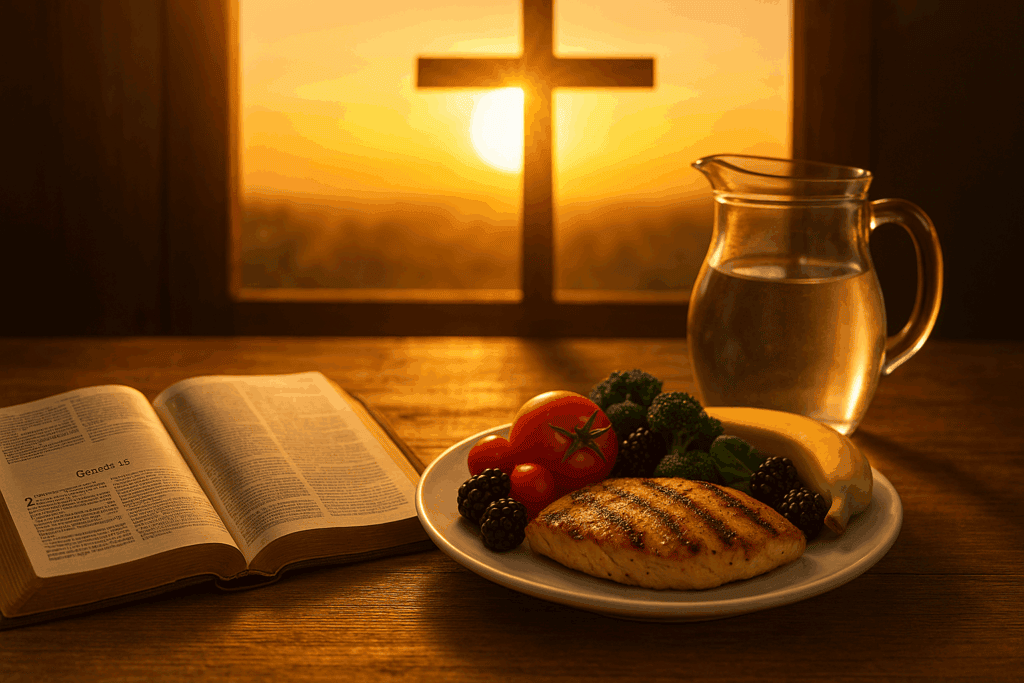
The fitness industry has a business model, and complexity is the product.
New macros. Meal timing windows. Supplements. New rules about what to eat before training, after training, and on rest days. The more complicated the system, the more you need the expert to decode it for you.
God didn’t design food that way.
In Genesis 1:29, before sin, before sickness, before the fall, God handed man a menu. Seed-bearing plants. Fruit from trees. Later, in Leviticus 11, He added clean meats. Combined with strategic fasting — a practice woven throughout scripture — these three elements form the complete biblical eating framework.
The Holy Diet is not a program you run for 30 days. It’s not a challenge with a start date and an end date. It’s the permanent way a Kingdom Gladiator eats — the eating framework that runs beneath every phase of Project Kingdom Gladiator from day one to completion.
Why the Answer Was Always in the Bible
Most Christian men have read Genesis and Leviticus more times than they’ve been consistent with a diet.
The answers were sitting there. God designed your body. He knew what it would need to run on. He told you in the same book you carry to church every Sunday.
The problem isn’t access to the information. It’s that nobody organized it into a system simple enough to follow. Dave Ramsey took biblical financial principles that had been available for thousands of years and built Financial Peace University. The Holy Diet does the same thing with food — it takes what God already said and organizes it into a framework a man can live inside for the rest of his life.
The First Diet God Ever Gave: Genesis 1:29
Before there was a fitness industry, before there was agriculture as we know it, before disease and obesity and processed food — God gave man a menu.
Genesis 1:29 (NIV):
“Then God said, ‘I give you every seed-bearing plant on the face of the whole earth and every tree that has fruit with seed in it. They will be yours for food.'”
Seed-bearing plants. That’s the foundation of the Holy Diet.
This category includes fruits, vegetables, legumes, nuts, seeds, and whole grains — every plant that produces its own seed. These are the foods God designed first. Before clean meats were added in Leviticus. Before fasting protocols were established throughout the Old Testament. The foundation was always plants.
Here’s what makes this specific. God didn’t say “eat whatever you want as long as it’s natural.” He named seed-bearing plants as the food. Plants that reproduce. Plants with seeds inside them. This distinction matters when you start reading ingredient labels and realize most of what fills grocery store shelves doesn’t meet this description.
The Addition of Clean Meats: Leviticus 11
After the fall and after the flood, God expanded the menu.
Leviticus 11 introduces clean and unclean animals — specific categories of animals God designated as food and animals He designated as off-limits. This wasn’t arbitrary. The animals God marked as clean are, almost universally, the animals that are leaner, higher in protein, and lower in the kinds of fats and toxins that unclean animals carry.
Clean meats you can eat:
Land animals that have split hooves and chew their cud. Beef, lamb, deer, and bison qualify. Pigs do not — they have split hooves but don’t chew their cud, which is why pork is off the Holy Diet.
Fish and seafood with fins and scales. Salmon, tilapia, tuna, cod, and bass are in. Shellfish — shrimp, lobster, crab, catfish — are out.
Birds listed as clean in scripture. Chicken, turkey, and duck make the list. Birds of prey and scavengers do not.
Why this matters nutritionally:
The clean animals are lean muscle builders. Beef, lamb, and wild-caught fish provide complete protein, healthy fats, and essential minerals. The unclean animals — pigs, shellfish, bottom feeders — are predominantly scavengers. Their biology is designed to process waste, which concentrates in their tissue in ways that don’t benefit the human body.
God knew this. He built it into the framework thousands of years before nutritional science could explain it.
Strategic Fasting: The Third Pillar
The Holy Diet is not just about what you eat. It includes when you don’t eat.
Fasting is not a trend. It’s not a biohacking technique someone discovered last decade. Scripture treats fasting as a normal discipline — Moses fasted, David fasted, Elijah fasted, Daniel fasted, Paul fasted, and Jesus fasted for 40 days before beginning His public ministry.
Strategic fasting in the Holy Diet framework means two things.
First, a daily eating window. Rather than grazing from the moment you wake up until the moment you sleep, you eat within a defined window and fast the rest of the time. This keeps insulin low, promotes fat burning, and gives your digestive system the rest it was designed to have.
Second, periodic extended fasts. The Adam Fast and the Daniel Fast both serve as resets within the broader Holy Diet framework — periods of restricted eating that break the body’s dependence on processed food, lower inflammation, and sharpen spiritual clarity.
Fasting is not punishment. In biblical practice, it’s surrender. A man who can tell his appetite no is a man who can lead.
The Holy Diet Food List: What You Eat
Seed-Bearing Plants (eat freely):
Vegetables of every kind — leafy greens, cruciferous vegetables like broccoli and cauliflower, root vegetables, squash, peppers, and cucumbers.
Fruits — apples, berries, bananas, citrus, melons, stone fruits. Whole fruit, not juice. The fiber in whole fruit is what separates it from sugar water.
Legumes — lentils, chickpeas, black beans, kidney beans. High protein, high fiber, slow-digesting. These were part of Daniel’s diet in Babylon and they belong in yours.
Nuts and seeds — almonds, walnuts, cashews, pumpkin seeds, sunflower seeds, chia seeds, flaxseed. These are calorie-dense, so keep portions reasonable.
Whole grains — brown rice, oats, quinoa, barley, and farro. Unprocessed, whole, as close to their natural state as possible.
Clean Meats (eat in moderation):
Beef and lamb from animals with split hooves that chew their cud. Wild game — venison, elk, bison — is excellent. Chicken and turkey qualify. Wild-caught fish with fins and scales: salmon, tuna, cod, tilapia, trout, and bass.
Water:
God’s original drink. Water is what your body runs on. Everything else is a deviation from the design.
The Holy Diet Food List: What You Don’t Eat
Pork and shellfish. Leviticus 11 is clear. This is the part of the Holy Diet that Christian men push back on most. Bacon is cultural. God’s framework is not.
Processed food. Anything manufactured in a facility, filled with preservatives, and engineered to override your satiety signals is off the Holy Diet. If it didn’t exist 200 years ago, it’s not on the plan.
Refined sugar. Table sugar, high-fructose corn syrup, and everything that carries them. Natural sweetness in whole fruit is fine. Concentrated sugar added to food is not.
Refined grains. White bread, white rice, white pasta, and anything made from bleached flour. These are seeds stripped of everything that makes them a seed-bearing plant. They spike blood sugar and provide almost nothing of value.
Industrial seed oils. Canola oil, soybean oil, corn oil, vegetable oil, and sunflower oil. These didn’t exist until the 20th century and they were never part of God’s design. Cook with nothing instead, or use small amounts of olive oil if needed.
Alcohol. Water is the drink. The Holy Diet doesn’t include alcohol as a regular part of eating.
How This Works in Practice
The Holy Diet sounds restrictive until you actually try it for two weeks.
Most men discover that the food list is larger than they thought, the meals are more satisfying than they expected, and the cravings for the food they gave up disappear faster than they believed possible.
A typical day on the Holy Diet looks like this:
Morning: Fast until hunger arrives naturally. Break the fast with whole fruit, oatmeal with nuts and seeds, or eggs if you’re past a fasting window.
Midday: A large plate of vegetables with a serving of clean meat. Salmon over a bed of greens with lentils and roasted sweet potato is a Holy Diet staple.
Evening: Lean meat with vegetables and a whole grain. Beef stir-fry with brown rice and broccoli. Grilled chicken with roasted root vegetables.
Fill your plate with seed-bearing plants, add clean meat, drink water, fast between meals, and repeat.
The Holy Diet Is Not a 30-Day Fix
Most men find this framework and ask when it ends.
It doesn’t end. That’s the point.
The fitness industry sells you a 30-day challenge because a permanent lifestyle change doesn’t require a monthly subscription. The Holy Diet is permanent because the body God designed doesn’t have an expiration date on how He designed it to be fueled.
This is not about being perfect. Missing a meal, eating something off the list at a family gathering, or having a hard week that sends you back to old habits — none of that disqualifies you. A Kingdom Gladiator gets back to the framework because he understands it’s not a diet. It’s a decision about how he treats the body God gave him.
Your body is a temple. The Holy Diet is how you treat it like one at the table.
Where the Holy Diet Fits in Project Kingdom Gladiator
The Holy Diet is Discipline 2 of the 7 Disciplines of the Kingdom Gladiator — and it runs beneath every other phase.
Most men begin with the Adam Fast — a 10-day biblical reset that breaks the body’s dependence on processed food before the Holy Diet begins. Others start with the Daniel Fast to clear inflammation and sharpen focus. Both of those resets lead to the same place: a man eating the Holy Diet for the long term.
During the ARK Blueprint, the Samson Strength System, the Armor of God, and the Cross Fit Phase — the Holy Diet never changes. The training phases shift. The eating framework stays constant. Seed-bearing plants, clean meats, strategic fasting, water.
Inside the Kingdom Gladiators community, men ask me every week about fine-tuning their nutrition. The answer is almost always the same: get back to the framework. The Holy Diet, consistently followed, produces results that no complicated protocol can match.
CONCLUSION
The fitness industry spent decades convincing men that eating right was complicated.
God wrote the answer in Genesis before the fitness industry existed.
Seed-bearing plants from Genesis 1:29. Clean meats from Leviticus 11. Strategic fasting from a practice woven through scripture from Moses to Paul. Water as the drink God designed the human body to run on.
The Holy Diet is not a hack. It’s not a shortcut. It’s the eating framework God built for the body He created — organized into something a man can follow for the rest of his life without an app, a coach, or a monthly subscription.
Start with the food list in this post. Remove one thing from the “don’t eat” list this week and replace it with something from the “eat freely” list. Make that one swap, hold it for seven days, and notice what happens to your energy, your hunger, and your mental clarity.
Then come join the men inside the Kingdom Gladiators Skool community who are doing this same work every day.
Which item on the “don’t eat” list is hardest for you to give up — and why do you think that is?