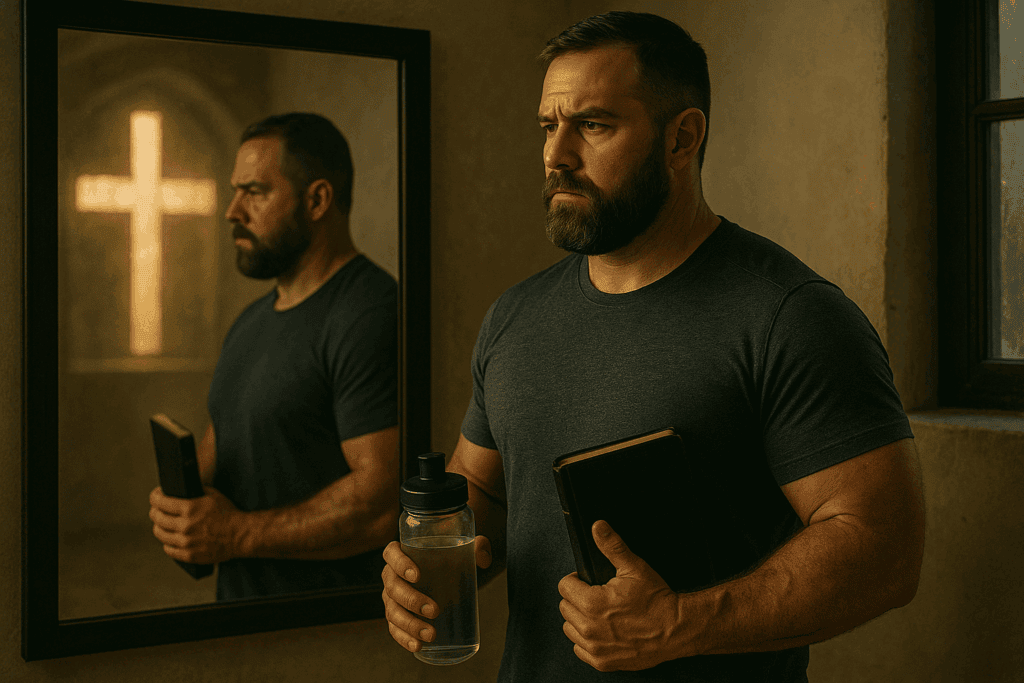
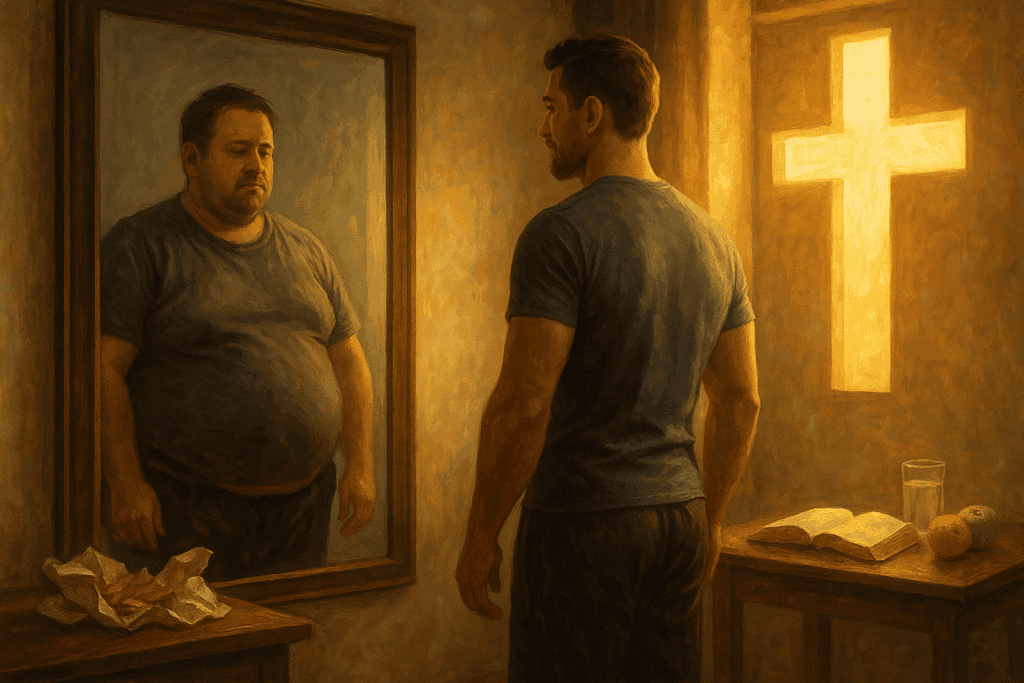
Somewhere this week you’ll hit a wall — a 5 a.m. alarm you don’t want to answer, a hard conversation you’d rather dodge, a trial with no end date in sight. Biblical mental toughness isn’t gritting your teeth until you break. It’s the God-sourced strength to keep obeying when your own strength runs out.
Biblical mental toughness is the God-sourced ability to keep obeying, working, and enduring through pain, delay, and discomfort — not the world’s version of gutting it out on raw willpower. Scripture builds it through men like David, who spent years as a hunted fugitive before he ever wore a crown, and Paul, who wrote “I have learned to be content” only after shipwrecks, beatings, and hunger (Philippians 4:11-13, NIV). Real toughness trains the body (1 Timothy 4:8), disciplines the mind, and still knows when to rest, because it draws on a source that doesn’t run dry. That’s what separates it from burnout dressed up as strength.
What Biblical Mental Toughness Actually Means
Secular mental toughness culture leans on one word: grit. Psychologist Angela Duckworth’s 2007 study in the Journal of Personality and Social Psychology tracked cadets through the brutal first summer at West Point. It also followed finalists at the National Spelling Bee. In both groups, a trait she called grit — sustained passion and perseverance toward a long-term goal — predicted who finished, even when raw talent alone didn’t. That’s a real, useful finding. It’s also incomplete for a Christian man.
Grit answers how you push through. It doesn’t answer why, or what you’re leaning on when your own reserves run empty. Paul gives the Christian answer directly: “My grace is sufficient for you, for my power is made perfect in weakness… For when I am weak, then I am strong” (2 Corinthians 12:9-10, NIV). Worldly toughness says dig deeper into yourself. Biblical toughness says your own tank was never meant to be the source.
That distinction matters because self-generated toughness has a ceiling. You can only grit your way through so much before you’re empty. Toughness sourced in God doesn’t ask you to be stronger than your circumstances — it asks you to keep obeying while leaning on Someone who already is.
David: Toughness Built Over Years, Not One Fight
Most men know David for one afternoon — a shepherd boy, a sling, a giant (1 Samuel 17). That story makes a great highlight reel, but it isn’t where David’s toughness came from. His real training ground was the decade that followed, running from a king who wanted him dead.
For years, David lived in caves and wilderness strongholds, hunted by Saul’s army, cut off from home and rest (1 Samuel 21-30). Psalm 57 carries the superscription “When he had fled from Saul into the cave” (NIV). Psalm 142 is titled simply “When he was in the cave” (NIV). Read either one and you find no toxic positivity — just an honest man telling God exactly how afraid and exhausted he is, and choosing to trust anyway.
The clearest picture comes after the worst day of that decade. David’s own camp at Ziklag was burned, his family taken, and his own men talked about stoning him. Scripture doesn’t gloss over how bad it got: “David was greatly distressed… each one was bitter in spirit because of his sons and daughters.” Then one sentence turns the whole scene: “But David found strength in the LORD his God” (1 Samuel 30:6, NIV).
That’s biblical mental toughness in one verse. Not a pep talk. Not gritted teeth. A man with nothing left, choosing where to put his weight.
Samson: When Strength Isn’t Toughness
Samson looks like the obvious pick for a post on toughness — a judge of Israel who killed a lion with his bare hands and took down a thousand men with a jawbone (Judges 14:6, 15:15). His story is in this post for the opposite reason. Samson proves that raw strength and real toughness aren’t the same thing.
Samson’s power was never his own; it was a gift tied to his Nazirite vow (Judges 13:5). What he lacked was the internal discipline to guard it. He chased what he wanted, ignored repeated warnings, and let Delilah wear him down until he gave up the secret of his strength (Judges 16:15-17). The most chilling line in the whole account comes right after: “He awoke from his sleep and thought, ‘I’ll go out as before and shake myself free.’ But he did not know that the LORD had left him” (Judges 16:20, NIV).
Physically, nothing about Samson had changed in that moment. He still had the same body. What was gone was the source. That’s the warning for any man chasing toughness through physical output alone. Muscle, endurance, and pain tolerance can all stay fully intact while the thing that actually matters — a life surrendered to God — quietly walks out the door. Proverbs puts the principle plainly: “Like a city whose walls are broken through is a person who lacks self-control” (Proverbs 25:28, NIV). Toughness without internal discipline is a wall with no gate.
Paul: The Secret of Contentment Isn’t a Feeling
Philippians 4:13 gets pulled onto gym walls and highlight reels more than almost any other verse — “I can do all this through him who gives me strength” (NIV). Read outside its context, it sounds like a promise of unlimited achievement. Read inside its context, it’s something sturdier: a hard-won conclusion about enduring want.
Paul writes it right after this: “I know what it is to be in need, and I know what it is to have plenty. I have learned the secret of being content in any and every situation, whether well fed or hungry, whether living in plenty or in want” (Philippians 4:12, NIV). The Greek behind “learned the secret” is memyemai — a word borrowed from the mystery religions of Paul’s day, meaning “I have been initiated.” Paul is saying contentment isn’t a mood he stumbled into. It’s a discipline he was trained into, through real scarcity.
The word behind “content” in verse 11, autarkeia, was also a favorite term of Stoic philosophers, who prized self-sufficiency as the goal. Paul borrows the word and flips its source. Stoic contentment comes from within, through sheer self-mastery. Paul’s contentment comes from Christ — trained through repeated exposure to both lack and plenty, not manufactured by willpower. That’s the same pattern from David’s cave and Samson’s downfall: toughness that holds up is toughness with the right source underneath it.
Jesus: The Toughest Endurance in Scripture
David, Samson, and Paul all point to something bigger than themselves. Christ is the model every other example in this post is borrowing from.
Before His public ministry started, Jesus fasted forty days in the wilderness, then faced direct temptation from Satan at His weakest, most depleted moment (Matthew 4:1-11). He didn’t win that fight on adrenaline. He answered every temptation with scripture, quoting Deuteronomy three separate times while His body had nothing left to give. That’s toughness with a source outside Himself, on full display.
The clearer picture comes the night before the cross. In Gethsemane, Jesus was in such distress that Luke, a physician, describes His sweat “like drops of blood falling to the ground” (Luke 22:44, NIV) — a real, physically documented stress response, not a figure of speech. He asked God three times to let the coming suffering pass. Then He said the sentence that defines biblical toughness better than any other verse in this post: “not my will, but yours be done” (Luke 22:42, NIV).
That’s not stoic detachment from pain. Jesus felt the full weight of what was coming and asked for another way. Toughness wasn’t pretending the suffering didn’t hurt. It was surrendering to the Father’s will anyway, in full view of the pain. If you want one verse to define the whole framework in this post, Gethsemane is it — a man honest about the cost, anchored in whose he was, choosing obedience over comfort with his eyes wide open.
Why Physical Training Builds Real Toughness
Paul didn’t treat the body as irrelevant to this. He used it as his go-to metaphor for discipline: “Everyone who competes in the games goes into strict training… I strike a blow to my body and make it my slave” (1 Corinthians 9:25-27, NIV). And he told Timothy plainly that “physical training is of some value” (1 Timothy 4:8, NIV) — real value, just not ultimate value next to godliness.
There’s a physical reason training builds toughness, not just a metaphorical one. A 2021 mouse study by Xirouchaki and colleagues, published in Science Advances, found that exercise triggers a hormetic response — a controlled, beneficial stress — through an enzyme called NOX4 in skeletal muscle. The temporary stress of a hard workout switches on the body’s own defense and repair systems, making it more resilient afterward. The researchers note that human studies are still needed to confirm the exact mechanism. But the pattern lines up with something clinicians already use: stress inoculation training, developed by psychologist Donald Meichenbaum. It builds coping capacity through controlled, graduated exposure to stress, not avoidance of it.
Hebrews 12:11 makes the same point in spiritual language, using the Greek word gymnazo — the root of “gymnasium.” “No discipline seems pleasant at the time, but painful. Later on, however, it produces a harvest of righteousness and peace for those who have been trained by it” (NIV). A hard workout, a fast, a hard conversation you don’t avoid — all of it can function as training, in the literal biblical sense of the word, if it’s done with the right goal instead of just for show.
Toughness vs. the Toxic Grind: Why Burnout Isn’t Strength
Here’s where a lot of “toughness” content quietly goes wrong. It treats rest as the opposite of discipline, so pushing through exhaustion gets mistaken for faith. Scripture doesn’t teach that, and neither does sports medicine.
Overtraining syndrome is a real, documented condition: fatigue and declining performance despite continued or increased training, along with mood changes, disrupted sleep, and chronic pain. According to Rady Children’s Health’s sports medicine program, “the only treatment for burnout is rest” — often four to twelve weeks of it, depending on severity. Grinding harder doesn’t fix a body or a soul that’s already depleted. It digs the hole deeper.
Elijah gives us the clearest biblical picture of this. Fresh off the biggest spiritual victory of his life on Mount Carmel, he collapsed under a broom tree and prayed to die: “I have had enough, LORD… take my life” (1 Kings 19:4, NIV). God’s response wasn’t a rebuke or a new assignment. An angel woke him twice, gave him food, and let him sleep — before a single word of correction or a new mission. Commentator David Guzik puts it well: “Sometimes the most spiritual thing a person can do is get enough rest and replenishment.” Biblical toughness includes knowing when the tough, faithful move is to eat, sleep, and let God rebuild you before you go again.
A Framework for Pushing Through Discomfort Without Burning Out
Toughness that lasts isn’t one move — it’s a repeatable pattern. Here’s a four-step framework built from what David, Samson’s failure, Paul, and Elijah all point toward: choose your discomfort on purpose, anchor your identity before the trial, treat recovery as part of the training, and let the process finish before you rush the lesson.
Step 1: Choose the Discomfort — Don’t Just Absorb It
Paul’s metaphor is “strict training,” not random suffering (1 Corinthians 9:25). Training is chosen: a hard workout, a fast, a cold shower, a difficult conversation you schedule instead of avoid. Suffering that lands on you uninvited — a diagnosis, a layoff, a wayward kid — is different, and it calls for endurance, not a training plan. Know which one you’re in. Chasing invented hardship while ignoring the real trial in front of you isn’t toughness; it’s a distraction wearing a workout shirt.
Step 2: Anchor Your Identity Before the Trial
Paul says he “learned the secret” of contentment — already settled, already initiated, before the next famine or feast arrived (Philippians 4:12). Samson never anchored anything; he was still leaning on strength he assumed would always be there. Get your identity settled in Christ before the hard week hits, not while you’re in the middle of it. A man who’s still trying to prove something under pressure breaks faster than one who already knows whose he is.
Step 3: Train the Rest as Hard as the Push
Overtraining research and Elijah’s broom tree say the same thing from two directions: recovery isn’t the absence of discipline, it’s part of it. Build real rest into your week — sleep, Sabbath, an actual day off from the grind — the same way you’d build in a hard training session. Skipping recovery doesn’t make you tougher. It just moves the day your body or your faith cashes the bill.
Step 4: Let the Trial Finish Its Work
“We also glory in our sufferings, because we know that suffering produces perseverance; perseverance, character; and character, hope” (Romans 5:3-4, NIV). James says almost the same thing: “Let perseverance finish its work so that you may be mature and complete” (James 1:4, NIV). Notice the order — you can’t skip from suffering straight to hope. Each stage has to run its course. Toughness isn’t rushing to the lesson before the trial has actually done its work in you.
Common Questions About Biblical Toughness, Answered Honestly
Isn’t this just Stoicism with Bible verses added on top? No — and Paul makes the difference explicit. He uses Stoic vocabulary (autarkeia, self-sufficiency) in Philippians 4:11, then relocates its source entirely. Stoic toughness runs on self-mastery. Biblical toughness runs on Christ’s strength supplied to you, which is why Paul can call himself weak and strong in the same breath (2 Corinthians 12:10).
Doesn’t “no pain, no gain” contradict resting? Only if you think rest is the opposite of discipline. It isn’t. Hebrews 12:11 says discipline produces its harvest “later on” — not instantly, and not without a recovery period built in. Elijah’s rest before his recommissioning wasn’t a break from toughness. It was part of it.
Is toughness even a Christian virtue, or is it just a gym trend? It’s both older and more specific than the gym trend version. Paul calls it “strict training” for an eternal prize (1 Corinthians 9:25). James calls it perseverance that produces maturity (James 1:4). The virtue isn’t new — it’s just gotten disconnected from its actual source in a lot of modern “toughness” content.
How is this different from just “having faith”? Faith is the anchor; toughness is what faith looks like when a trial doesn’t end on your schedule. David had faith in the cave and still wrote honest, fearful psalms while he waited. Job had faith and still said, “though he slay me, yet will I hope in him” (Job 13:15, NIV), in the middle of loss he never got a full explanation for. Biblical toughness isn’t the absence of struggle inside your faith — it’s continuing to obey and trust while the struggle is still happening.
A Word for the Women Reading This
Everything above applies to you as much as to the man in your life. David’s cave psalms, Paul’s contentment in scarcity, and Elijah’s exhaustion aren’t men-only material — they’re the honest record of what it looks like to keep trusting God through a long, hard season. If you’re walking alongside a husband or son who’s grinding himself into the ground and calling it faith, Elijah’s story is worth handing him directly. The tough, faithful move is sometimes food and sleep before the next assignment, for him and for you.
Building Toughness Through Physical Training
This is where physical training earns its place in a Christian man’s life, beyond looking or feeling better. Temple Training, the fitness progression inside Project Kingdom Gladiator, is built around the same principle Paul used with Timothy. Your body is a real, legitimate training ground for discipline — even though it isn’t the ultimate goal. See the /treating-your-body-as-a-temple/ post for the full progression, from walking with God as your entry-level cardio to the Samson Strength lifting program.
Fasting works the same way. The free Kingdom Reset 5-Day Fast is voluntary, chosen discomfort — Step 1 of the framework above, in practice. Five days of water only won’t make you a warrior on its own. But it’s a controlled place to practice choosing discomfort on purpose, anchoring your identity before you’re hungry, and finding out God’s strength really is sufficient when yours runs out. Read the /fasting/ post for how to prepare for your first one safely.
Real Toughness Outlasts the Grind
Worldly toughness burns bright and burns out — it has to, because it’s running on a tank that empties. Biblical mental toughness runs on a source that doesn’t. David found strength in the Lord with nothing left of his own. Paul learned contentment through actual want, not a slogan. Elijah rested before he was recommissioned, and God didn’t call that weakness.
If you want a place to start practicing this instead of just reading about it, the free Kingdom Reset 5-Day Fast inside the Kingdom Gladiators Skool community is built for exactly that: five days, water only, alongside men choosing real discomfort on purpose instead of drifting into another Monday they didn’t plan for.